

Barbell Overhead Press: Essential Form and Technique Guide

Key Highlights
-
The barbell overhead press is a fundamental exercise for upper body strength, but proper form—such as maintaining a straight bar path—is essential to maximize results and prevent injury. Some experts caution against this lift due to the stress it places on the shoulders and lower back, especially if form is poor. Individuals with previous shoulder issues or limited mobility should assess their capabilities and consult a fitness professional before adding this exercise to their routine.
-
Mastering proper form, including a straight bar path, is crucial to maximize gains and prevent injury.
-
This exercise primarily targets your shoulders and deltoids but also engages your triceps, upper chest, and core.
-
Understanding the difference between the overhead press and variations like the push press can diversify your workouts.
-
Warm-ups focusing on thoracic extension and shoulder external rotation can significantly improve your overhead press technique.
-
Beginners should start with lighter weights to perfect their form before progressing to heavier loads.
Introduction
Are you looking to build serious shoulder strength and muscle mass? The barbell overhead press is one of the most effective compound movements for your upper body. However, many people struggle to perform it correctly, limiting their gains and increasing the risk of injury. This guide will break down everything you need to know about this powerful exercise. From understanding the muscles involved to mastering proper form, you'll learn how to perfect your overhead press for maximum results and safety.
Understanding the Barbell Overhead Press
The barbell overhead press, also known as the military press or shoulder press, is a fundamental strength training exercise. It involves lifting a barbell from a starting position at your shoulders to an overhead position with your arms fully extended. This powerful movement is a staple in many workout routines for a good reason.
To get the most out of the exercise, you must focus on proper technique. A straight bar path and correct body alignment are essential for effectively targeting the right muscles and avoiding strain. Let's explore what makes this lift unique and how it compares to other techniques.
What Makes the Barbell Overhead Press Unique
What sets the barbell overhead press apart from other shoulder exercises? Its ability to engage a wide range of muscles simultaneously makes it a highly efficient compound lift. Unlike isolation movements, the shoulder press requires your entire body to work in unison to stabilize and lift the weight. This comprehensive activation is key to building functional strength that translates to real-world activities.
The movement demands significant stability from your shoulder joint, core, and even your lower body. The correct form for performing the barbell overhead press involves maintaining a stable base, engaging your core, and pressing the bar in a straight vertical path. This forces your body to develop both strength and coordination.
When performed correctly, the overhead press is one of the best ways to build bigger, stronger shoulders. The unique challenge it presents promotes muscle growth and improves your ability to handle heavy loads safely, making it a cornerstone of any serious strength program.
Traditional vs. Barbell Overhead Press Techniques
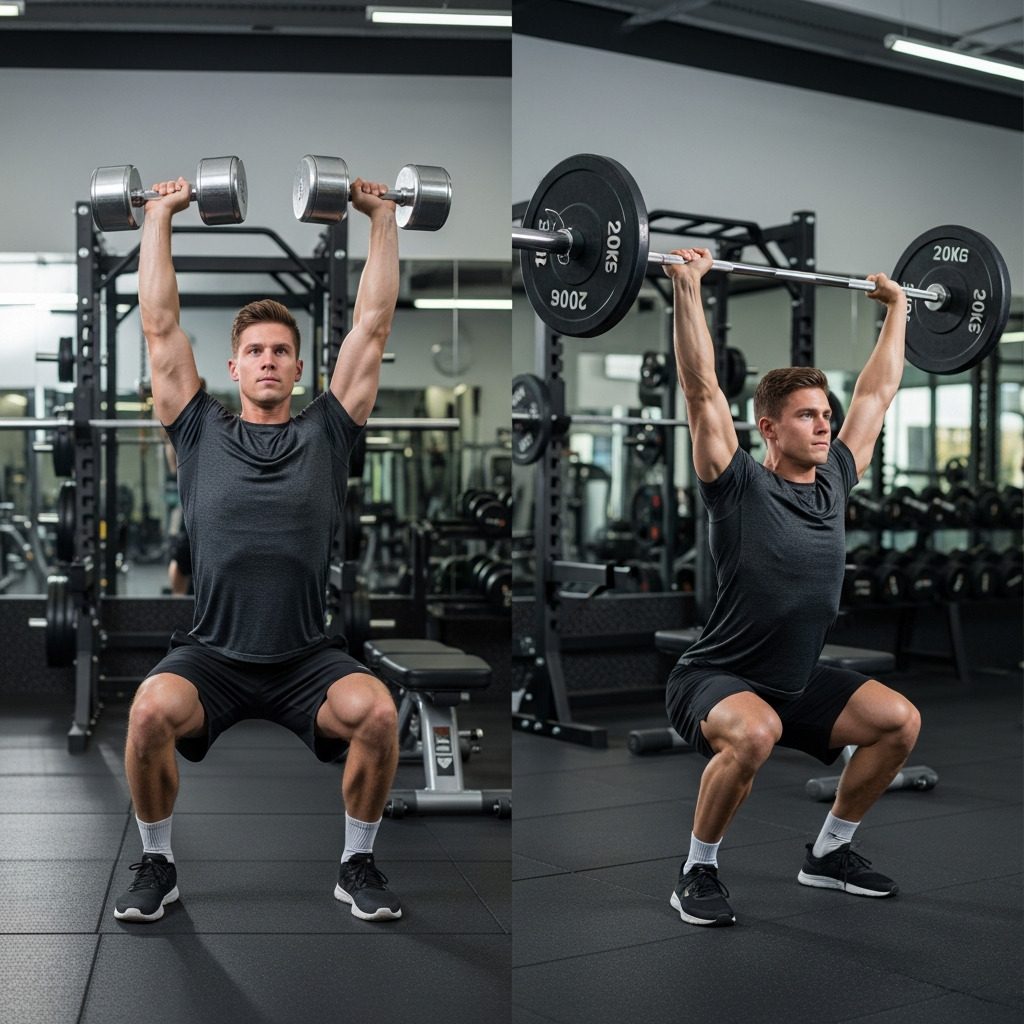
While the terms "traditional overhead press" and "barbell overhead press" are often used interchangeably, there can be subtle differences in technique. The standard overhead press focuses on strict form, using only upper body strength to lift the weight. In contrast, some variations might incorporate slight leg drive.
The barbell version is particularly effective for strength athletes because it allows for progressive overload with heavy weights. However, is the barbell overhead press suitable for all fitness levels? Beginners may find it challenging and might start with dumbbells to build foundational strength and master the proper technique first.
Here's a simple comparison to clarify the focus of each approach:
|
Feature |
Standard Overhead Press |
Barbell Overhead Press |
|---|---|---|
|
Primary Goal |
Building strict upper body strength and muscle. |
Maximizing strength and power with heavy loads. |
|
Technique Focus |
Strict form with minimal body movement. |
Efficient bar path and full-body stability. |
|
Suitability |
All levels, with weight adjusted accordingly. |
Intermediate to advanced lifters, or beginners with coaching. |
(ALSO READ: 8 Must-Try Barbell Workouts for Total Body Strength)
Muscles Activated During the Barbell Overhead Press

The barbell overhead press is far more than just a shoulder exercise; it's a full-body movement that activates numerous muscle groups. While the shoulders are the primary movers, many other muscles work together to stabilize your body and assist in the lift. This compound nature is what makes the overhead press so effective for building overall upper body strength.
Understanding the primary muscles and supporting players involved helps you create a mind-muscle connection, leading to better form and more significant gains. Let's look at the key muscles worked during this exercise.
Primary Movers: Shoulders and Deltoids
When you perform an overhead press, your shoulders do most of the heavy lifting. The deltoids, which are the main muscles of the shoulder, are the primary movers. These muscles have three distinct heads: the anterior (front), lateral (middle), and posterior (rear) deltoids. The overhead press primarily targets the anterior and lateral deltoids, which are responsible for lifting your arms forward and to the side.
What muscles are worked during the barbell overhead press? Along with the deltoids, the upper chest, specifically the clavicular head of the pectoralis major, also plays a significant role, especially at the beginning of the lift. This muscle assists in pushing the bar off your shoulders and getting the movement started.
By engaging these key muscle groups, the overhead press helps you build well-rounded, powerful shoulders. Consistent training with proper form will lead to noticeable gains in both size and strength in your delts and upper chest.
Supporting Muscles: Triceps, Core, and Upper Back
While your shoulders are the star of the show, they can't do it all alone. Several supporting muscles are crucial for a successful and safe shoulder press. Your triceps are essential for extending your elbows and locking out the weight at the top of the movement. Without strong triceps, you'll struggle to complete the lift.
Your core muscles, including your abs and obliques, provide the stability needed to keep your torso upright and rigid. A tight, braced core prevents your lower back from arching excessively and transfers power efficiently from your lower body to the barbell. This core engagement is vital for maintaining proper posture throughout the lift.
Additionally, the muscles of your upper back, such as the traps and rhomboids, help stabilize your shoulder blades. This scapular stability creates a solid platform for your arms to press from, ensuring the shoulder joint moves safely and effectively.
Key Benefits of the Barbell Overhead Press
Incorporating the barbell press into your routine offers a wide array of benefits beyond just bigger shoulders. As one of the most effective compound lifts, it is a fantastic tool for building raw upper body strength and increasing muscle mass. The full-body coordination required also improves your overall athleticism and stability.
The advantages of the overhead press extend beyond the weight room, translating directly into everyday activities. Let's examine how this exercise can enhance your strength and functional fitness.
Enhancing Upper Body Strength
If your goal is to build a powerful upper body, the barbell overhead press should be a staple in your training. This exercise is one of the best for developing raw pushing strength. Because it's a compound movement, it allows you to lift heavier weights than you could with isolation exercises, which is a key driver of strength gains.
What are the main benefits of including the barbell overhead press in my workout routine? One of the primary advantages is its impact on overall upper body strength. The press challenges your shoulders, triceps, and upper chest simultaneously, leading to balanced muscular development. Stronger shoulders and triceps will also have a direct carryover to other pressing movements, like the bench press.
By progressively adding weight to your barbell overhead press, you force your muscles to adapt and grow stronger. This process not only builds impressive strength but also contributes to a more muscular and defined upper body physique.
Functional Fitness and Everyday Movements
The strength you build from the shoulder press isn't just for show; it has practical applications in your daily life. This is a core component of functional fitness, which focuses on training your body to handle real-world activities more easily and safely. Think about how often you lift objects overhead, whether it's putting a heavy box on a high shelf or lifting your child into the air.
The overhead movement pattern is fundamental to human function. By strengthening the muscles involved in this motion, you improve your capacity to perform these tasks without strain or injury. Strength training with exercises like the shoulder press helps you move with more confidence and efficiency.
Regularly practicing the overhead press builds a foundation of strength that makes everyday movements feel effortless. It reinforces proper lifting mechanics and strengthens the stabilizing muscles that protect your joints, making it a valuable addition to any fitness program.
Foundation of Proper Barbell Overhead Press Form
Mastering the barbell overhead press starts with a solid foundation. Proper form is non-negotiable, as it ensures you are targeting the right muscles effectively while minimizing your risk of injury. Every detail, from your grip and stance to your posture and bar path, plays a crucial role in a successful lift. A slight mistake in your setup can compromise your strength and safety.
Before you even think about adding weight, it’s essential to perfect the fundamentals. Let's break down the key elements of proper form, starting with how you hold the bar.
Hand and Grip Positioning Essentials
Your grip is the first point of contact with the barbell, and getting it right is crucial for both power and safety. The ideal grip width for the barbell overhead press is slightly wider than shoulder width. This position allows for optimal force production and keeps your wrists and elbows in a safe alignment. A grip that is too wide or too narrow can place unnecessary stress on your joints.
You should use a full overhand grip, with your thumbs wrapped around the bar. This ensures the bar stays firmly in place and avoids any slipping. The barbell should rest in the heel of your palm, directly over your forearm, which ensures your wrists stay straight and stacked over your elbows.
Here are a few key points for your grip:
-
Grip Width: Position your hands just outside of your shoulders.
-
Bar Placement: Let the bar sit in the meaty part of your palm, not on your fingers.
-
Wrist Alignment: Keep your wrists straight and neutral, avoiding excessive bending.
Answering the question, "What is the correct form for performing the barbell overhead press?" begins with this solid, stable grip.
Foot Stance and Posture Guidelines
Your stance and posture create the stable base from which you'll press the weight. For the standing overhead press, your feet should be positioned about shoulder-width apart. This provides a solid foundation and allows you to generate force from the ground up. Point your toes slightly outward if it feels more comfortable and stable.
From this starting position, maintaining good posture is critical. Stand tall with your chest up and your shoulders back. Before you lift, engage your core by bracing your abdominal muscles as if you're about to take a punch. Squeeze your glutes to stabilize your pelvis and lower back.
This rigid, upright posture is essential for a safe and powerful press. A common mistake is to lean back excessively, which turns the exercise into an incline press and puts stress on your spine. By focusing on a strong, stable stance and good form from the start, you set yourself up for a successful lift.
Step-by-Step Barbell Overhead Press Technique
Now that you understand the foundational elements of form, it's time to put them all together. Executing the barbell overhead press with proper technique involves a sequence of precise movements, from setting up the lift to lowering the bar with control. Each step is designed to maximize muscle activation while ensuring your joints are protected.
A smooth, efficient lift is the goal. This means maintaining control throughout the entire range of motion and focusing on a clean bar path. Rushing the movement or using momentum can compromise your form and lead to injury. Let's walk through the process step-by-step to ensure you perform the exercise correctly and safely.
Setting Up Safely for the Lift
A safe lift begins with a proper setup. Start by setting the barbell in a power rack at about upper chest or shoulder height. This allows you to unrack the bar without having to squat down or press it up from a low position. Approach the bar and establish your grip, slightly wider than your shoulders.
Position yourself under the bar so it rests across your upper chest and front shoulders. Your elbows should be slightly in front of the bar, not flared out to the sides. Maintain a neutral position with your spine, engage your core, and take a deep breath.
Follow these steps to unrack the bar:
-
Dip slightly at the knees and drive up to lift the bar from the rack.
-
Take one or two steps back to clear the J-hooks.
-
Set your feet at shoulder width and re-engage your core and glutes.
This starting position, similar to the top of a bench press but standing, ensures you are stable and ready to press. "What is the correct form for performing the barbell overhead press?" The answer is in this careful preparation.
Executing the Press with Correct Alignment
With the bar in the rack position, you're ready to press. Before you initiate the overhead movement, ensure your core stability is locked in. Take a deep breath, brace your abs, and squeeze your glutes. This creates a solid base to press from. The key to a successful press is a straight bar path.
To achieve this, you'll need to slightly tilt your head back to clear a path for the barbell. As you press the bar upward, think about driving it straight toward the ceiling. Once the bar passes your forehead, push your head "through the window" created by your arms, returning it to a neutral position. Continue pressing until your arms are fully extended overhead, with your biceps near your ears.
Lower the bar back down with control. Reverse the movement, bringing the bar back to the starting position at shoulder level. Do not let it crash down. Maintaining control on the way down is just as important as the press itself.
Avoiding Common Mistakes and Injury Risks

The overhead press is an incredible exercise, but it comes with a risk of injury if performed with poor form. Common mistakes can lead to everything from minor strains to serious shoulder issues. Understanding these pitfalls is the first step toward avoiding them and ensuring your training is both safe and effective.
Many errors stem from trying to lift too much weight too soon or simply not knowing the correct technique. Let's identify these common mistakes and discuss how to correct them to protect your body.
Incorrect Bar Path and Body Position
One of the most frequent mistakes in the standard overhead press is an incorrect bar path. Lifters often press the bar out in front of their body in an arc instead of straight up. This inefficient path places significant stress on the shoulder joint and reduces the amount of weight you can lift. The bar should travel in a vertical line from your shoulders to the overhead position.
This error often happens because lifters fail to move their head out of the way. Remember to tilt your head back as the bar moves up and push it forward once the bar clears your face. Another issue is poor form in body positioning, such as excessive leaning back. This shifts the load to the upper chest and spine, defeating the purpose of the shoulder exercise.
To fix these issues:
-
Focus on pushing your head "through" your arms at the top.
-
Keep your core tight and glutes squeezed to prevent leaning back.
-
Practice with an empty bar to ingrain the correct vertical bar path. What are some ways to prevent typical errors during the barbell overhead press? The answer is by focusing on these technical details.
Recognizing and Preventing Shoulder Strain
Shoulder strain is a significant risk of injury associated with the overhead press, especially when form is compromised. Pain or discomfort during or after the exercise is a clear signal that something is wrong. Ignoring these signs can lead to more serious conditions like shoulder impingement or rotator cuff tears. Listen to your body and don't push through sharp pain.
To prevent shoulder strain, proper warm-ups are essential. Focus on mobility drills that externally rotate the shoulders and promote thoracic extension. If you feel shoulder pain during the barbell overhead press, stop the exercise immediately. You may need to reduce the weight, correct your form, or consult a physical therapist to address any underlying mobility or stability issues.
A key strategy for prevention is to press in the scapular plane, which is a slightly forward angle rather than directly out to the sides. This position is more natural for the shoulder joint and can reduce stress. Always prioritize safe technique over lifting heavy.
Popular Variations of the Barbell Overhead Press
Once you've mastered the standard barbell overhead press, you might want to explore some variations to challenge your muscles in new ways. Different versions of the lift can help you break through plateaus, build explosive power, or focus on specific aspects of your strength. An overhead press variation can add variety to your routine and keep your training exciting.
Two of the most popular variations are the push press and the strict press, each with its own unique benefits. Let's explore these and other options to diversify your shoulder workouts.
Push Press and Strict Press Differences
The main difference between the push press and the strict press lies in the use of your lower body. The strict press, as its name implies, requires you to use only your upper body strength to lift the barbell overhead. It demands strict form with no momentum from your legs, making it excellent for building raw shoulder and triceps strength.
In contrast, the push press incorporates a "dip and drive" motion with your legs. You initiate the movement by bending your knees and hips slightly, then explosively extending them to generate momentum and help drive the bar off your shoulders. This allows you to lift heavier weights than you could with a strict press, making it a great tool for developing power.
Key differences include:
-
Strict Press: No leg involvement; focuses on pure upper body strength.
-
Push Press: Uses leg drive to generate momentum and lift heavier loads.
-
Goal: The strict press builds foundational strength, while the push press develops explosive power.
"What are some variations of the barbell overhead press that I can try?" The push press is a fantastic choice for power development.
Seated and Single-Arm Barbell Overhead Press
Another popular variation is the seated barbell overhead press. Performing the exercise from a seated position removes the stability demands on your lower body and core, allowing you to isolate your shoulder and triceps muscles more directly. This can be a useful tool for focusing purely on upper body muscle growth. However, it can place more stress on the spine if not performed with a supportive bench.
For a unilateral challenge, you can try the single-arm barbell overhead press, though a dumbbell shoulder press is more common. Working one arm at a time helps identify and correct strength imbalances between your left and right sides. It also forces your core to work harder to prevent your torso from rotating. Both of these variations can target the muscle groups in unique ways.
Tips for Beginners Starting the Barbell Overhead Press
If you're new to the barbell overhead press, approaching it with a smart strategy is key to building a strong foundation and staying injury-free. Beginners should prioritize learning the correct form over lifting heavy weight. It’s a good way to ensure long-term progress and avoid developing bad habits that can be difficult to correct later.
Jumping in too quickly can lead to frustration and potential injury. Prioritize learning the movement pattern thoroughly before anything else. Let's go over some essential tips to help you get started on the right foot.
Choosing the Right Weight and Warm-Up Routines
For beginners, selecting the right starting weight is crucial. "Are there any beginner tips for starting the barbell overhead press safely?" Absolutely. Start with just the empty barbell (which typically weighs 45 pounds). This allows you to focus entirely on your technique without the struggle of a heavy weight. Only once you can perform several sets with perfect form should you consider adding small plates.
A proper warm-up is non-negotiable. Before you even touch the barbell, perform dynamic stretches and mobility drills for your shoulders, upper back, and wrists. A great warm-up exercise is the plate press-out:
-
Grasp a lightweight plate using a neutral grip.
-
Press it overhead and back as far as you can, focusing on thoracic extension and shoulder rotation.
-
Perform 5-10 reps to prime your muscles for the shoulder press.
A strength coach can provide valuable feedback on your form and help you choose an appropriate starting weight.
How to Progress Over Time for Safety and Results
Once you're comfortable with the form, it's time to think about how to progress. The key to long-term results with the barbell press is gradual, consistent progression. Avoid the temptation to increase the weight too quickly, as this is a common way to invite poor form and risk of injury. Instead, focus on small, manageable jumps in weight.
"What steps can I take to prevent typical errors during the barbell overhead press? One way is by progressing intelligently. Aim to add just 5 pounds to the bar at a time. Another way to progress is by increasing your reps. If you can complete all your sets and reps with good form, you're ready to add a little more weight in your next session.
Listen to your body. If you feel pain or your form starts to break down, it's a sign to scale back. Consistent, patient effort is the safest and most effective way to get stronger and build a powerful upper body.
Barbell Overhead Press for Shoulder Health
When performed correctly, the barbell overhead press is not just a muscle-builder but also a powerful tool for promoting long-term shoulder health. The exercise strengthens the muscles that support and stabilize the shoulder joint, which can help protect it from injuries in sports and daily life. Proper overhead pressing mechanics teach your shoulders to move through a full, healthy range of motion under load.
However, the key is proper execution. Poor form can do more harm than good, so a focus on technique is paramount. Achieving the right balance between shoulder mobility and stability is crucial for keeping your shoulders strong and resilient. When you prioritize safe practices, the overhead press can be a cornerstone of a healthy, functional upper body for years to come. Let's explore how to achieve this balance and practice safely.
Balancing Mobility and Stability in Your Shoulders
Healthy shoulders require a delicate balance between mobility and stability. Mobility allows your shoulder joint to move freely through its full range of motion, while stability ensures the joint is secure and controlled during that movement. The barbell overhead press demands both. You need enough shoulder mobility to get your arms fully overhead without restriction.
At the same time, you need the stability from your rotator cuff and upper back muscles to keep the head of the humerus centered in the shoulder socket. In addition, core stability is essential to provide a solid base for the press. "How does the barbell overhead press support overall shoulder health?" It does so by training these two qualities simultaneously.
If you lack mobility, your body will compensate, often by arching the back or flaring the elbows, which can lead to injury. If you lack stability, the joint becomes vulnerable to strain. Therefore, your training should include drills that improve both mobility and stability.
Safe Practicing Strategies for Lifelong Results
To ensure the shoulder press remains a beneficial part of your routine for years to come, adopting safe practicing strategies is essential. First and foremost, never sacrifice proper form for heavier weight. Master the movement with a lighter load before you even think about pushing your limits. Building strong core strength is another critical component, as a stable trunk protects your spine and supports the lift.
Incorporate warm-up drills that encourage external rotation and thoracic extension to prepare your shoulders for the demands of the exercise. Pay attention to what your body is telling you; avoid forcing yourself to continue if you're experiencing pain. If you experience discomfort, it might be a sign to step back, reassess your technique, or consult a professional.
By prioritizing these safe practices, you can enjoy the strength and muscle-building benefits of the shoulder press while minimizing risks. This smart, patient approach is the key to achieving lifelong results and maintaining healthy, resilient shoulders.
barbell overhead press or dumb bell shoulder press?
The choice between the barbell overhead press and the dumbbell shoulder press depends on your fitness goals. The barbell overhead press allows for heavier lifting, promoting overall strength. In contrast, the dumbbell shoulder press improves stability and targets muscles more effectively. Both exercises have unique benefits for shoulder development.
Conclusion
In conclusion, mastering the barbell overhead press is not just about lifting weights but understanding the form, technique, and the muscles involved. By focusing on proper alignment and avoiding common mistakes, you can enhance your upper body strength while minimizing the risk of injury. Remember to progress at your own pace and incorporate variations to keep your workouts fresh and effective. Whether you're a beginner or an experienced lifter, prioritizing the essentials of this lift will benefit both your fitness journey and shoulder health. If you're ready to elevate your training regimen, consider booking a free consultation with our experts to refine your technique and achieve your fitness goals!
REFERENCE:
https://www.wahoofitness.com/wahoo-sports-science
https://aasgaardco.com/category/training/coach-development/
https://aasgaardco.com/store/books-posters-dvd/books/starting-strength-basic-barbell-training/
https://www.startingstrengthgyms.com/indianapolis/free-session.html
https://www.ncbi.nlm.nih.gov/pmc/articles/PMC6548056/
https://www.livescience.com/author/harry-bullmore
https://www.bodybuilding.com/content/how-to-overhead-press-a-beginners-guide.html