

Key Highlights
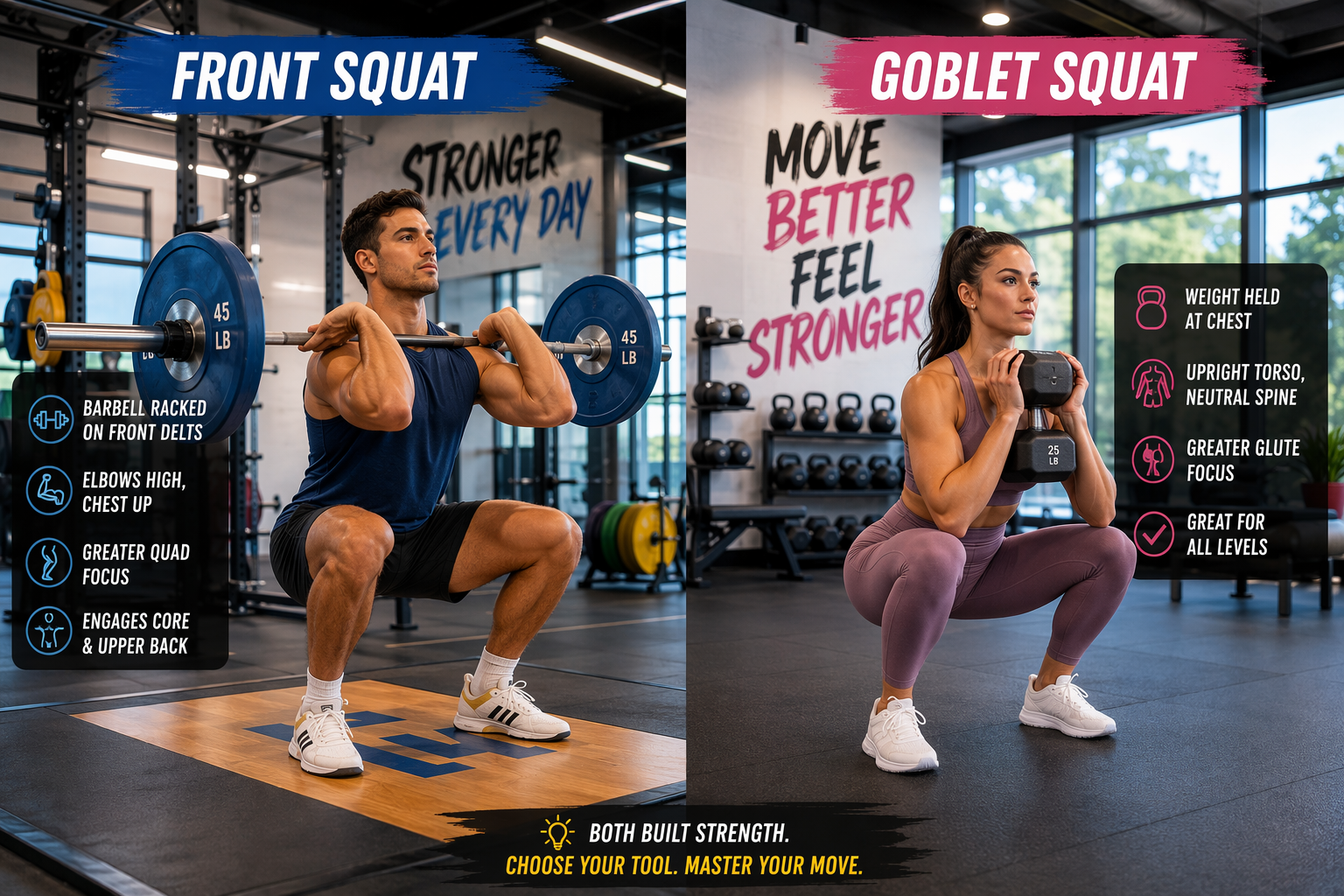
- The goblet squat is one of the most beginner-friendly squat variations for learning control and balance.
- A front squat lets you use heavier loading, which can support lower body strength and muscle growth.
- Both lifts train similar lower body muscles, especially the quads, glutes, and core.
- The front squat needs more mobility, setup skill, and upper body stability than the goblet squat.
- The goblet squat is more accessible because you only need one weight.
- Your best choice depends on experience, goals, and available equipment.
- Introduction
The squat movement pattern sits at the center of many training plans because it builds strength, control, and confidence. If you want a lower body strength exercise that supports proper squat mechanics, both the front squat and goblet squat deserve attention. Each one can improve large ranges of motion and help with athletic performance, but they do not ask the same thing from your body. So which one fits you better? It starts with understanding how these two squats compare.
(TO KNOW MORE: Front Squat Exercise: Key Form Tips for Success)
Front squat vs goblet squat: An Overview
Among squat variations, the front squat, Zercher squat, and goblet squat are all front-loaded options built around the same fundamental movement pattern. In both, the load sits at the front of the body, which encourages an upright torso and solid control through the descent and ascent.
Still, they are not identical. The front squat uses a barbell in a rack position across the shoulders, while the goblet squat uses a single weight held close to the chest. That difference changes setup, loading, and difficulty. Let’s break down each lift.
What Is a Front Squat?
A front squat is a barbell squat where the bar rests across the front of your shoulders. You support it in the front rack position with your elbows pointed forward in 90 degrees flexion, so the bar stays in place. Most people set it up from a squat rack, which makes it easier to unrack and return the bar safely.
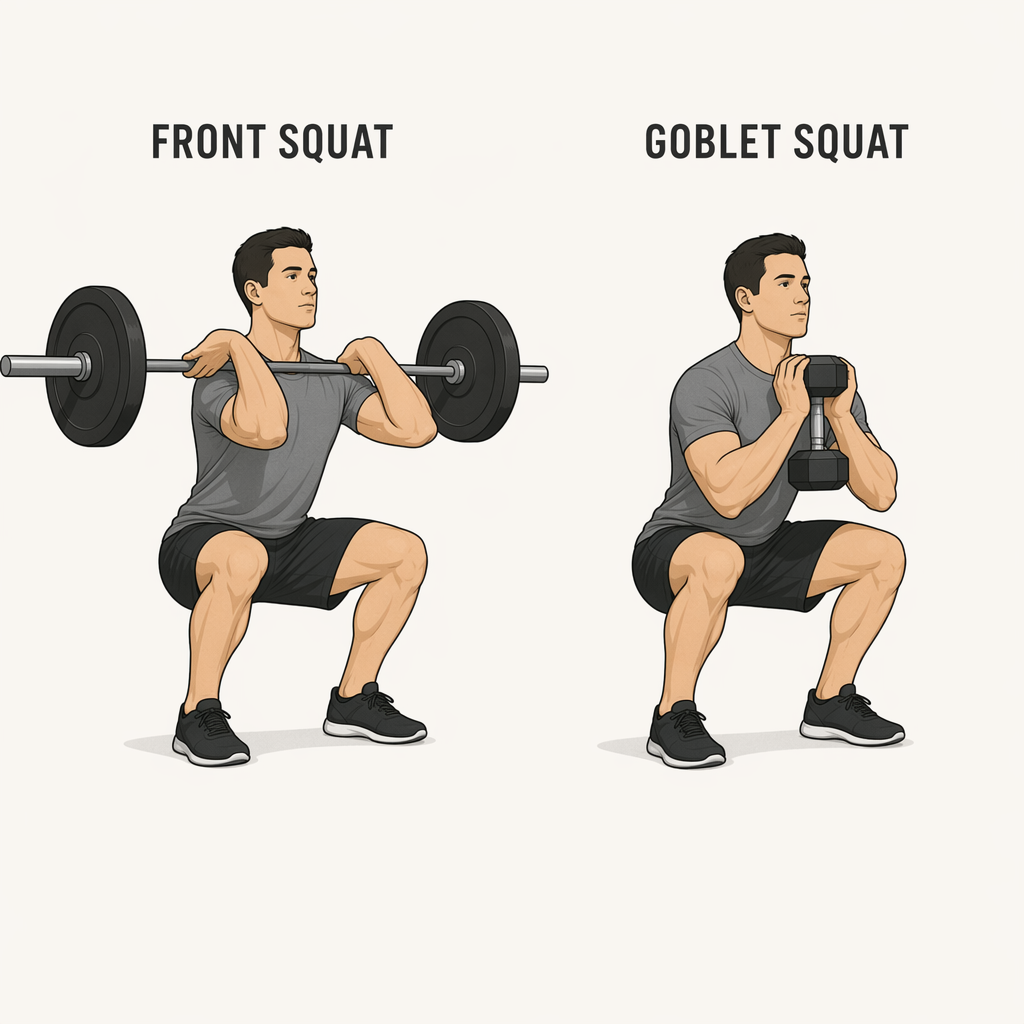
Because the load sits high and in front, your body needs an upright trunk position to stay balanced. That means the front squat places strong demands on your core, upper back, and posture while also training the lower body. It is often used as a more advanced exercise for strength development, increasing the difficulty level of your workout.
The main differences between the front squat and goblet squat come down to load, setup, and skill. A front squat allows for a general comparison of heavier loading, but it also asks for more mobility, control, and technical proficiency than the goblet version.
What Is a Goblet Squat?
A goblet squat is a regular squat performed while holding a weight in front of their chest at the front of your chest. You usually use a dumbbell or kettlebell and keep it close to your body with a goblet grip. That front-loaded hold helps many people stay balanced and feel more secure during the movement.
This variation is widely used to teach proper squat mechanics. Since the load is lighter and easier to manage, beginners can focus on depth, knee tracking, and control through a full range of motion without worrying as much about a complex setup.
Compared with the front squat, the goblet squat is simpler to learn and easier to access. You do not need a rack or barbell, and the position is usually more comfortable on the wrists and shoulders, even if it limits how heavy you can go.
Key Differences Between the Front Squat and Goblet Squat
At a glance, these squat variations look similar because both are front-loaded and train many of the same main muscles. Your quads, glutes, core, and upper back all work hard in each lift, including the back squat, and both support sound squat mechanics.
The bigger differences show up in execution. The front squat needs more technical proficiency, more mobility, and more upper body stability. It also allows heavier weights. The goblet squat is easier to learn, but arm and upper back fatigue often become the limiting factor. The next sections compare those details more closely.
Equipment Involved: Barbell vs. Dumbbell or Kettlebell
Equipment changes the training effect more than many people expect. The front squat uses a barbell, usually with plates and a squat rack, allowing for greater depth and heavier loading possible, which is one reason the exercise is so useful for building lower body strength over time.
By contrast, the goblet squat uses one dumbbell or kettlebell held at the chest. This makes the lift far more accessible. You can start quickly, learn the pattern, and train safely with low to moderate loads. The tradeoff is that your upper body may tire before your legs do.
|
Equipment |
Front Squat |
Goblet Squat |
|---|---|---|
|
Main tool |
Barbell |
Dumbbell or kettlebell |
|
Setup needs |
Often needs a squat rack and plates |
Needs only one weight |
|
Loading potential |
Supports heavier loading |
Usually limited to lighter loads |
|
Common effect |
Better for long-term strength progression |
Better for learning and accessibility |
Body Position and Setup for Each Squat Variation
Setup is one of the clearest differences between these lifts. In a front squat, the bar sits on the shoulders in a rack position. Your elbows stay forward, your chest stays up, and your body works to keep the bar from rolling. That makes the setup more technical from the start.
With a goblet squat, you hold a dumbbell or kettlebell close to your chest. The weight is easier to control, so many people can focus faster on the squat movement pattern itself. This often helps beginners find better balance and confidence right away.
Both lifts encourage an upright torso and use a large range of motion at the hips, knees, and ankles. Still, the front squat asks for greater shoulder demands from the shoulders and wrists, while the goblet setup is usually easier to manage for everyday training and coaching.
Muscles Targeted and Activation Patterns
Both exercises work many of the same main muscles, so there is a lot of overlap in their activation patterns. In each lift, the lower body does most of the driving, with the quads taking a strong role and the glutes helping through the movement.
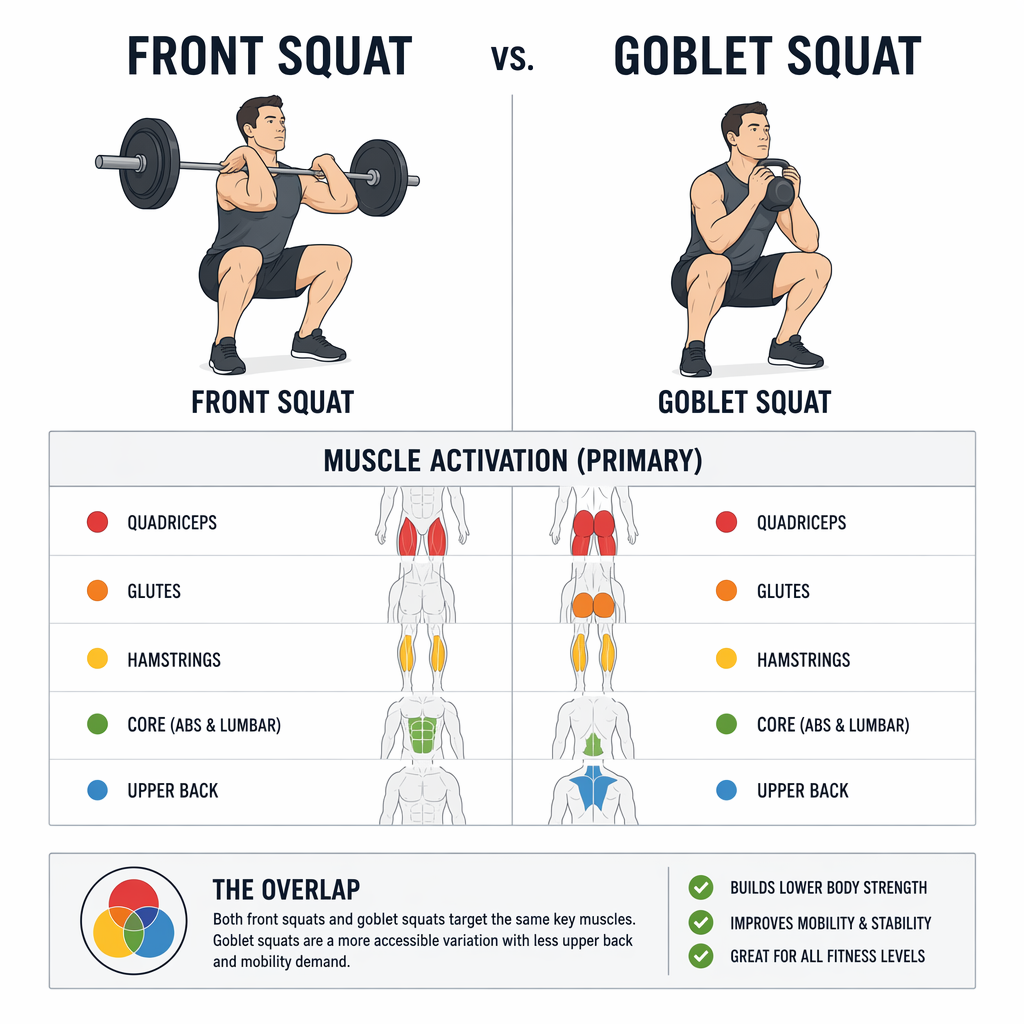
There is still an important difference. The front squat demands greater demand on the core and upper back muscles because the barbell must stay supported across the shoulders. That extra postural challenge can matter for muscle growth and strength goals. Here is a closer look at which areas do the work.
Primary Muscle Groups Worked
The front squat and goblet squat both target the lower body in very similar ways. Each places a strong emphasis on the quads and also trains the glutes, adductors, abductors, and core, especially under heavy loads. Because both are front-loaded, they also ask the trunk to stay tall and stable throughout the lift.
That said, front squatting generally targets the back muscles and erector spinae more than the goblet squat. The barbell position increases the demand on your posture, especially when loads get heavier. It also requires you to keep the knees tracking well, which supports safe mechanics around the knee ligaments.
- Quads do much of the work in both squat variations.
- Glutes help drive you up from the bottom position.
- Erector spinae and upper back work harder in the front squat.
- Both lifts rely on good knee tracking to protect knee ligaments.
If your goal is building leg strength, the front squat is usually more effective because it allows heavier loading.
Core Engagement and Upper Body Demands
When people ask about core engagement, the front squat usually comes out ahead. The barbell sits across the front of the shoulders, so your core muscles and upper back must work hard to stop you from folding forward and developing power qualities. As the load rises, that demand becomes even clearer.
The goblet squat also challenges the trunk, but in a more manageable way. Holding a dumbbell or kettlebell at the chest still trains bracing and posture, yet the lighter loading reduces the overall technical demand. That makes it a useful teaching tool without the same level of whole-body strain.
- Front squats demand substantial engagement of the quads and more core engagement under load.
- Goblet squats still train bracing, just with less stress.
- The front squat challenges the upper body more through posture control.
- The goblet squat is easier to maintain for beginners.
So, how does the front squat compare to the goblet squat in terms of core activation? It places a greater demand on the trunk and upper back, especially during heavier sets.
Technique, Learning Curve, and Common Mistakes
Not every good exercise is an excellent exercise that is equally easy to learn. The goblet squat has lower technical demand, so many lifters can find proper form faster. It gives you a simple way to practice depth, balance, and control without managing a complicated rack position.
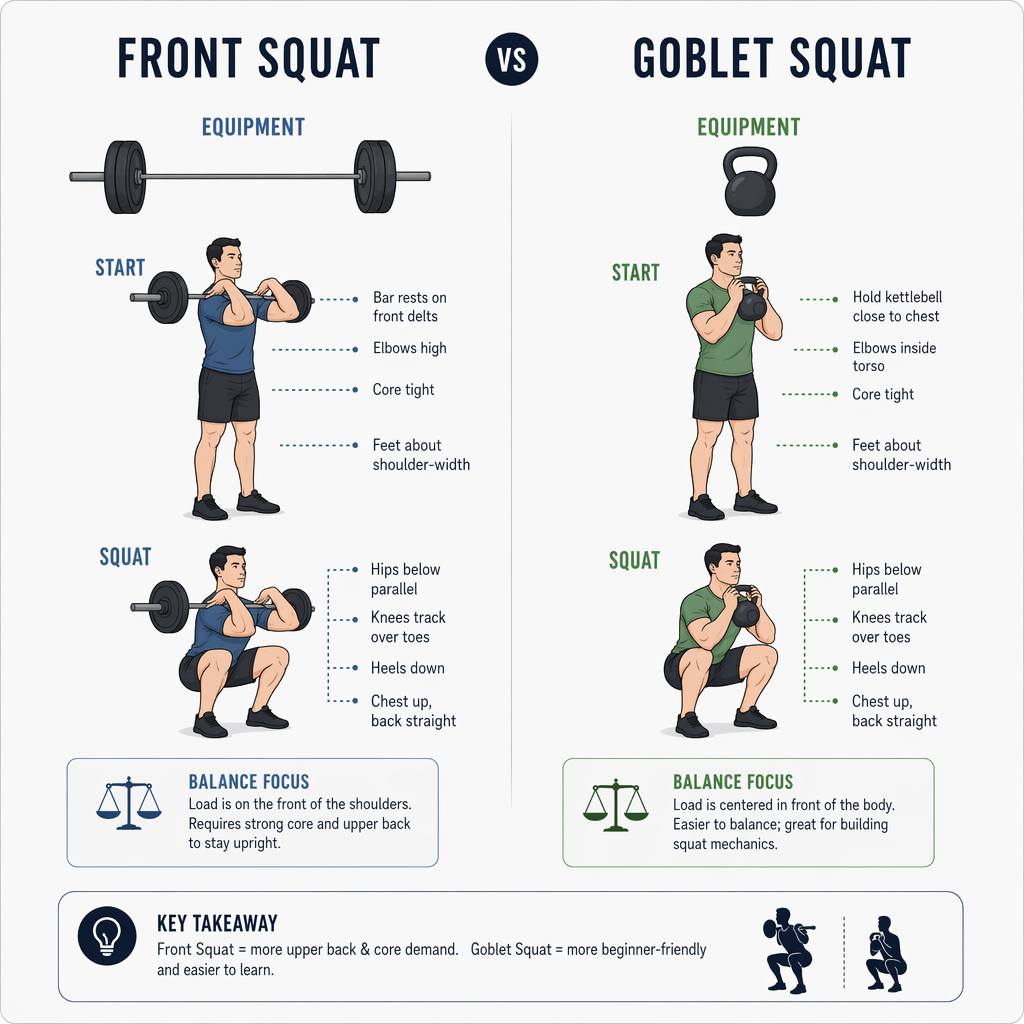 The front squat has a steeper learning curve. It needs higher technical proficiency, more mobility, and stronger posture to keep the bar secure. That makes common mistakes more likely if your skill level is not ready. Before choosing one, it helps to know how to perform each well.
(ALSO READ: Discover the Benefits of Front Squats for Strength Gains)
How to Master Proper Form for Both Squats
Mastering proper form starts with choosing the right lift for your current level. For most people, the goblet squat has the easier learning curve. The simple equipment setup and front-held load help you stay balanced while you practice sitting down and standing up with control.
The front squat takes more patience. You need to learn the front rack, keep an upright torso, and maintain proper engagement of the upper body so the bar stays in place. If your wrists, shoulders, or posture break down, the lift becomes much harder to control.
- Start with a load you can manage smoothly.
- Keep your chest up and maintain an upright torso.
- Let your knees track over your toes.
- Choose equipment that matches your skill and mobility.
So, is it easier to learn proper form with the goblet squat or the front squat? For most beginners, the goblet squat is easier because it is less technical and more forgiving.
Frequent Errors in Front Squats and Goblet Squats
A few common mistakes show up in both lifts. People often lose balance, cut depth short, or let the knees cave inward. These issues can disrupt the squat movement pattern and reduce the quality of the rep, no matter which version you choose.
Front squats bring extra problems because the bar must stay secure on the shoulders. If your elbows drop, your chest falls, or you lose your upright trunk position, the lift can tip forward. In the goblet squat, the usual limiting factor is different: your arms and upper back may fatigue before your legs get enough work.
- Letting the knees collapse inward
- Losing an upright trunk position
- Shortening the range of motion
- Dropping the elbows in the front squat
What are some common mistakes people make with the front squat compared to the goblet squat? Front squat errors are usually tied to posture and bar position, while goblet squat problems often come from upper body fatigue and limited loading.
When to Choose Each Squat Variation
Choosing between these lifts depends on what you need right now. Your skill level matters, but so do your goals, equipment, and comfort with front-loaded work. For some people, accessibility and ease of learning make the goblet squat the smarter pick.
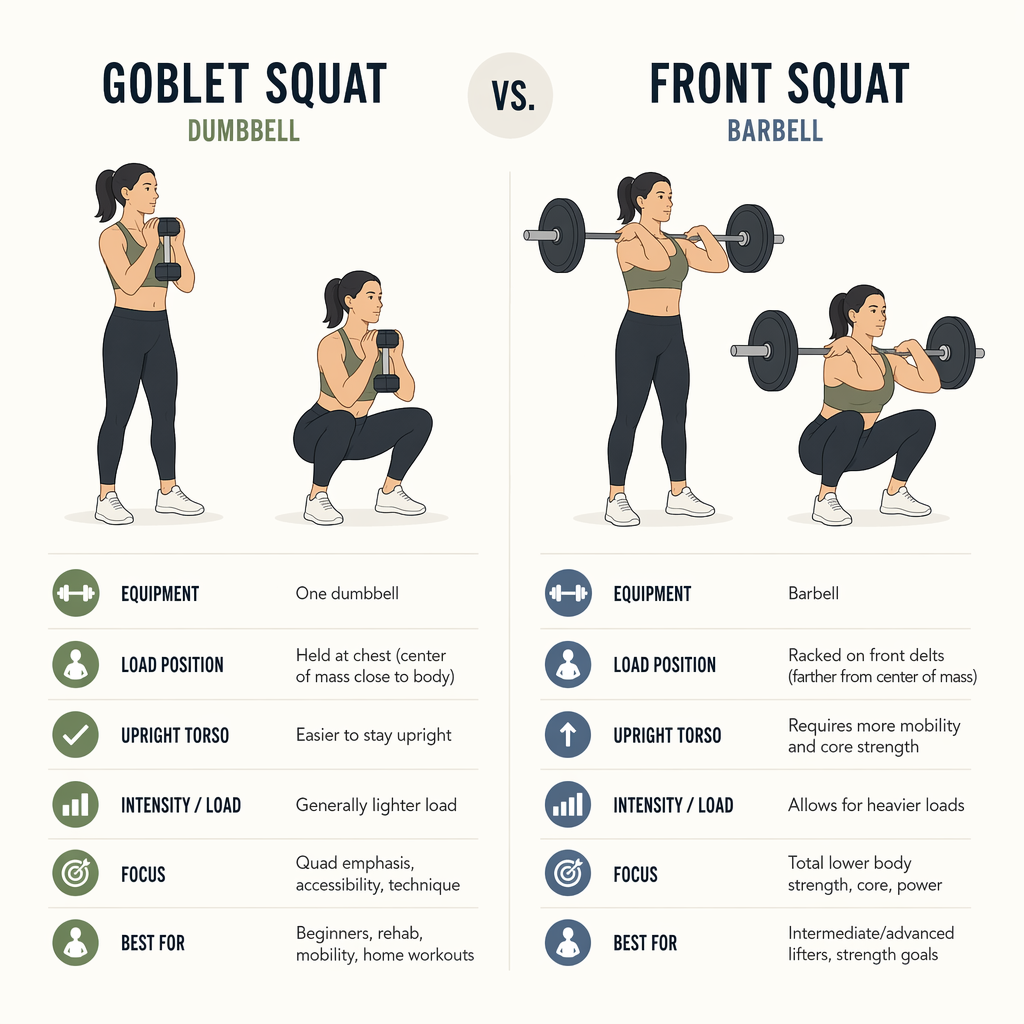
For others, the front squat fits better because it supports heavier strength work and enhances upper body strength, as well as more advanced progress. Individual factors such as mobility, training history, and tolerance for the rack position all play a role. The next two sections make program suitability much easier to judge.
Training Goals, Skill Level, and Program Suitability
Your training goals should guide the decision. If you are new to squatting, the goblet squat is often the better place to start. It is a cornerstone of strength and a strong stepping stone that helps you learn depth, torso control, and confidence before moving to more demanding lifts.
If your focus is strength development, the front squat usually makes more sense. It supports heavier loads and challenges the body in ways that can better serve athletic performance and the development of lower limb strength. It is often better suited to intermediate and advanced lifters who already own the movement.
- Choose goblet squats if you are a beginner.
- Choose front squats if your goal is heavier strength work.
- Use goblet squats to build skill before progressing.
- Match the lift to your current skill level and setup.
Can you substitute the goblet squat for the front squat in most training programs? It can work as a temporary substitute for learning and basic training, but it does not replace the front squat when heavier strength progression is the goal.
Limitations and Accessibility of Each Squat
The goblet squat wins on accessibility. You need only one weight, the setup is simple, and the position feels natural for most people. That makes it a practical option at home, in a busy gym, or in early-stage coaching sessions.
Its main limitations show up as you get stronger. Because the weight is held by the arms and upper torso, the goblet squat often becomes hard to overload with heavier weights. In many cases, your upper body gives out before your legs do, which limits the lower body training effect.
- Goblet squats are easy to access and teach.
- Front squats have higher technical demand.
- Goblet squats are harder to progress with heavier weights.
- Front squats may be uncomfortable with limited shoulder or wrist mobility.
Are there any limitations to the goblet squat compared to the front squat? Yes. It is easier to learn, but it usually has less loading potential and can be restricted by arm and upper back fatigue.
(ALSO READ: Top 6 Front Squat Alternatives for Building Leg Strength)
Conclusion
In conclusion, understanding the similarities and differences between the front squat and goblet squat is essential for optimizing your workout routine. Each variation has its unique advantages, whether it's the equipment involved or the specific muscle groups targeted. By mastering the proper technique and being mindful of common mistakes, you can effectively incorporate both squats into your training program to suit your goals and skill level, especially if you're aiming to build significant strength. Don't hesitate to experiment with each squat to discover what works best for your body and fitness journey. If you're ready to elevate your strength training, consider reaching out for a consultation to refine your technique and achieve better results!
What are the benefits of the Goblet squat vs the back squat?
The Goblet squat offers several benefits over the back squat, including improved form for beginners, enhanced core stability, and reduced strain on the lower back. It also promotes better mobility and balance, making it an excellent choice for those looking to build strength while minimizing injury risk during workouts.
REFERENCE:
https://sportscienceinsider.com/how-to-do-barbell-hip-thrusts/
https://www.healthline.com/health/fitness-exercise/best-blogs-of-the-year#6
https://www.roguefitness.com/weightlifting-bars-plates/barbells
https://pubmed.ncbi.nlm.nih.gov/32509107/
https://www.healthline.com/health/fitness-exercise/best-blogs-of-the-year
https://www.ncbi.nlm.nih.gov/pubmed/19002072
https://www.roguefitness.com/conditioning/strength-equipment/kettlebells