

Key Highlights
- The pendulum squat and hack squat are both effective squat machine options for leg development.
- A pendulum squat uses an arcing movement pattern, while a hack squat follows a more fixed path.
- Both support leg strength and reduce lower back demand compared with many free-weight choices.
- Muscle activation differs slightly, with each machine shifting emphasis across muscle groups.
- Proper technique and foot placement strongly affect comfort, depth, and training results.
- Your best choice depends on goals, space, experience, and preferred leg training style.
Introduction
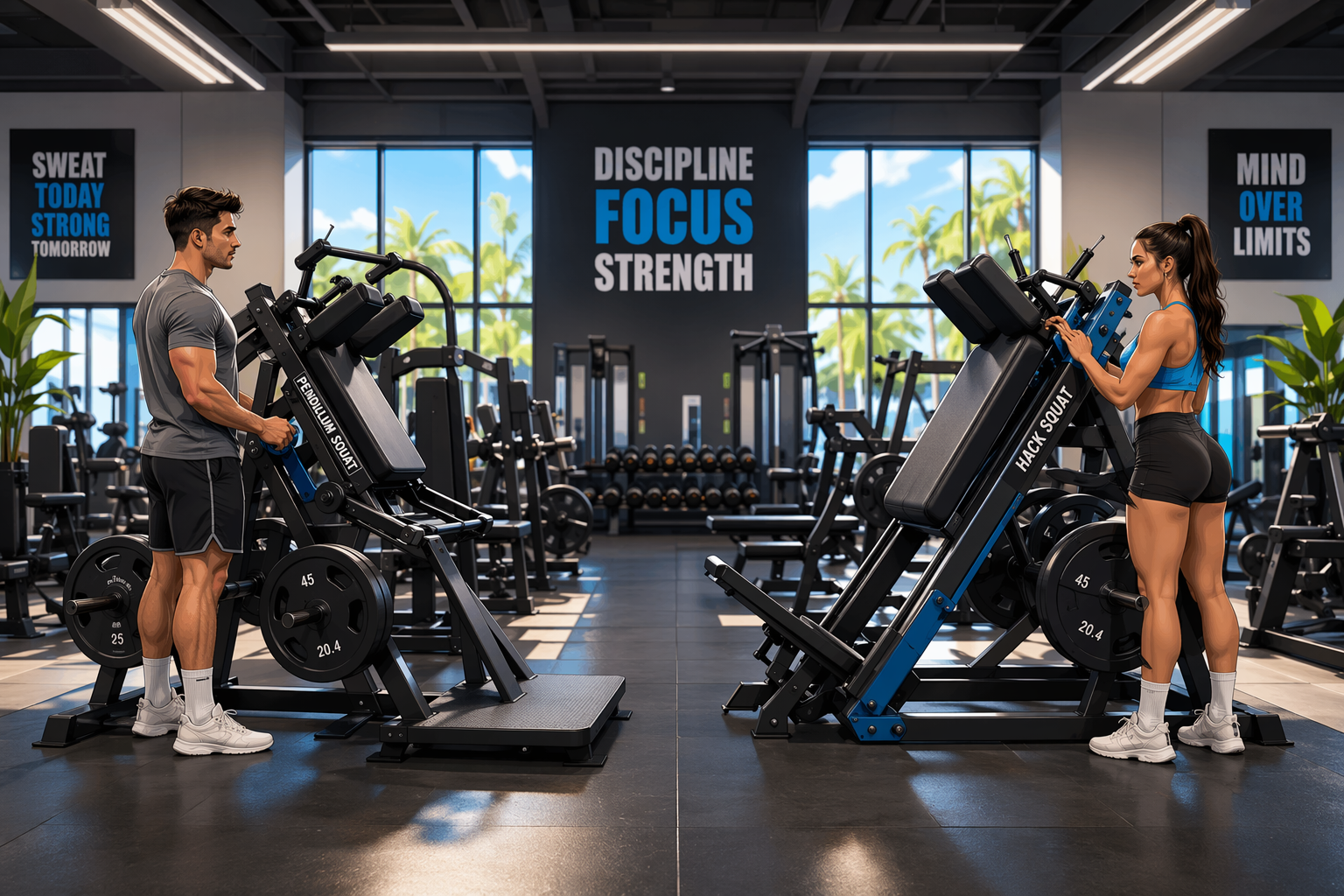
When you compare one squat machine to another, the pendulum squat and hack squat usually rise to the top. Both can build your lower body with less balance demand than traditional squats, but they do not feel the same. A pendulum squat uses a swinging path, while a hack squat keeps you on a more fixed track. So which one is more effective for your workouts? That depends on your goals, comfort, and how you want to train your legs.
What Are Pendulum Squats and Hack Squats?
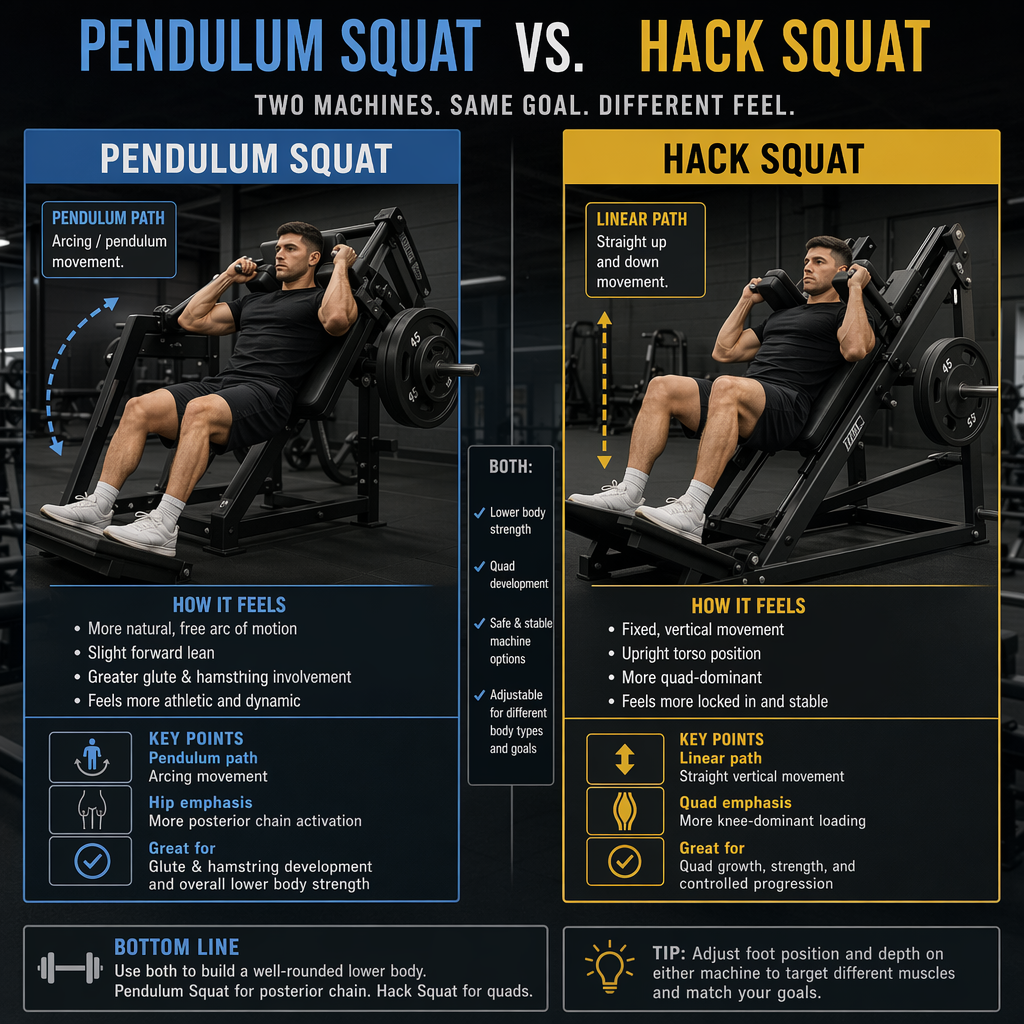
A pendulum squat and a hack squat are both machine-based leg exercises designed to train your lower body through a guided movement pattern. Compared with traditional squats, each squat variation gives you more support and helps you focus on key leg muscles without needing as much balance or upper body control.
The main difference is how the machines move and which muscle groups get greater emphasis. A pendulum squat tends to bias the quads while still involving the glutes and hamstrings. A hack squat also targets the quads, but many lifters use it for a broader lower-body feel. That difference starts with machine design.
(TO KNOW MORE: What Is a Pendulum Squat? Form Tips and Techniques)
Overview of the Pendulum Squat Machine
The pendulum squat machine guides you through a curved, swinging movement path instead of a straight line. That design helps create a very controlled squat and can make the exercise feel smooth from the starting position to the top. For many users, it also allows a deeper range of motion than other machine options.
Once you’re set up correctly, the machine helps keep proper alignment while reducing the need to manage balance on your own. This is one reason many people find it friendly to use. You can focus on pushing hard with your legs instead of worrying about the bar drifting or your torso tipping forward.
In practice, the pendulum squat machine is strongly quad-dominant, so muscle activation in the front of the thighs is high. It still involves some stabilizer muscles, plus secondary work from the glutes and hamstrings. If your goal is direct quad work with support, this machine stands out.
How Hack Squat Machines Work
A hack squat machine usually places your back against a pad while your feet press into a platform. The sled moves on a vertical or slightly angled track, giving you a fixed movement pattern. That setup makes the exercise feel stable and easy to learn, especially when compared with free-weight squats.
Because the machine gives firm back support, you can train hard with less concern about balance or bar position. Many lifters like this for building leg strength safely. It also keeps lower back stress low, which can help if your back tends to limit your squat sessions before your legs do.
Foot placement matters a lot here. A lower and narrower stance usually pushes more emphasis onto the quads for quad development, while a higher stance can shift more work toward the glutes and hamstrings. The hack squat machine is simple, direct, and built for focused leg training.
(ALSO READ: Barbell Hack Squat: A Hidden Gem for Leg Day Gains
Key Technique Differences Between Pendulum Squat and Hack Squat
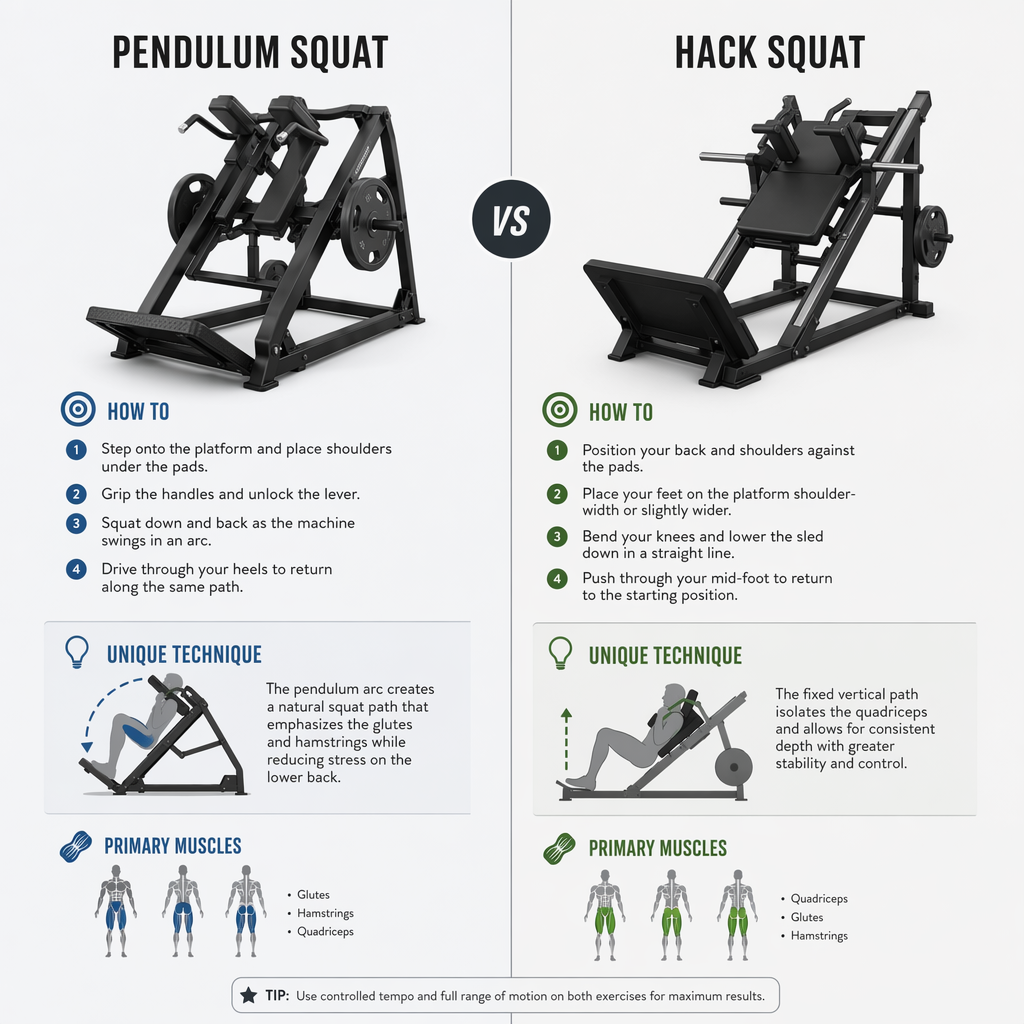
Technique is where these two machines really separate. The movement pattern on a pendulum squat follows an arc, while the hack squat uses a more fixed track. That changes your range of motion, the way your lower body travels, and how the exercise feels at the bottom.
Proper technique also depends on foot placement and body position. Some lifters find the hack squat easier to learn because the path feels more obvious. Others prefer the pendulum squat because it allows a deeper squat and a smoother descent. Those setup details shape the training effect.
Movement Pattern and Range of Motion
The biggest difference between these machines is how your body moves through each rep. On a pendulum squat machine, the movement pattern follows a curved arc. On a hack squat machine, the path is more linear or angled. That single design change affects comfort, depth, and how pressure feels through the knees and hips.
Many lifters find the pendulum squat better for deeper squats because the arc can support a more natural descent. The hack squat still offers a strong range of motion, but some users may feel more restriction depending on machine design and body shape. Your starting position and depth tolerance matter on both.
|
Feature |
Pendulum Squat |
Hack Squat |
|---|---|---|
|
Movement pattern |
Curved, swinging arc |
Fixed vertical or angled track |
|
Starting position |
Set under pads with body aligned to arc |
Back against pad, feet on platform |
|
Range of motion |
Often allows deeper squats |
Good depth, but can feel more fixed |
|
Knee flexion feel |
Variable through the rep |
More consistent through the rep |
|
Knee comfort |
May feel smoother for some users |
Stable, but depends on setup |
Setup, Foot Placement, and Body Positioning
Good results start with proper setup. Even the best squat machine can feel awkward if your stance is off. Body positioning changes how the movement path lines up with your joints, and that affects comfort in your knees, hips, and lower back.
For beginners, the hack squat often feels easier right away because the back pad and track give clear support. The pendulum squat is still beginner-friendly, but the arc can take a few reps to understand. In both cases, controlled reps matter more than heavy loading.
Keep these basics in mind:
- Place your feet where you can keep steady pressure through the whole foot.
- Use foot placement to shift emphasis, lower for quads and higher for more glutes or hamstrings.
- Maintain body positioning that keeps your back supported and chest stable.
- Avoid letting your knees collapse inward during deeper knee flexion.
- Match your stance to the machine’s movement path instead of forcing an awkward position.
(ALSO READ: 7 Effective Barbell Back Squat Alternatives to Try Toda)
Muscle Activation in Pendulum Squats vs Hack Squats
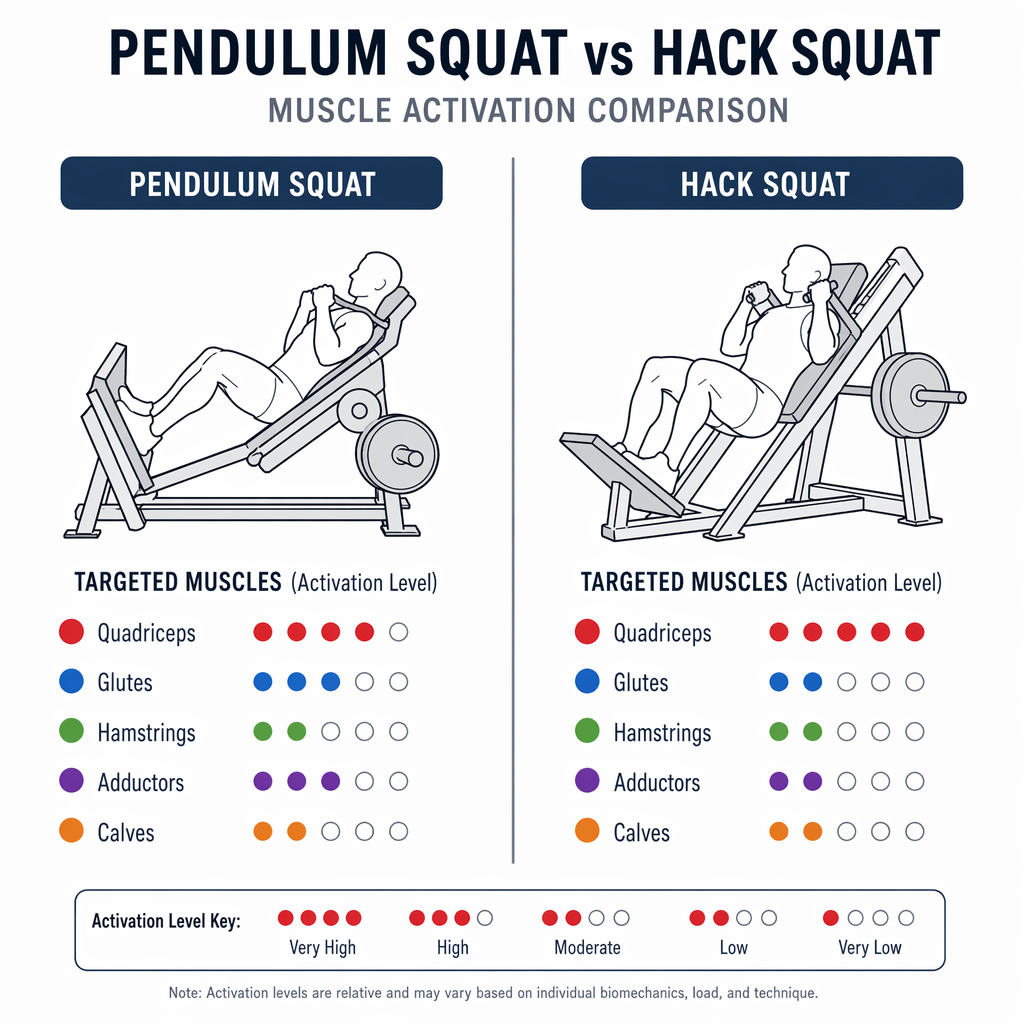
Both machines train the same major leg muscles, but muscle activation is not identical. In each squat machine, the primary muscle group is usually the quads. That said, the movement pattern changes how much work the glutes, hamstrings, and stabilizer muscles contribute.
The pendulum squat is often described as more quad-dominant, while the hack squat can feel more evenly spread across several leg muscles depending on stance. So if you are asking which works the quads more effectively, the pendulum squat may have a slight edge. Let’s break that down by muscle area.
Quads, Glutes, and Hamstring Engagement
When it comes to quads, both machines do a strong job. The pendulum squat is known for heavy quad bias, which can make it great for direct thigh work and leg strength. The hack squat also targets the quads hard, but many lifters feel more contribution from nearby muscle groups depending on stance and depth.
Within the quads, all major areas work during both lifts. That includes the vastus medialis, rectus femoris, vastus lateralis, and vastus intermedius. The hack squat can also bring in more glutes and hamstrings when foot position shifts higher on the platform.
Here is the practical difference:
- Pendulum squat usually gives greater emphasis to the quads.
- Hack squat often feels more balanced across quads, glutes, and hamstrings.
- Higher foot placement increases glute and hamstring involvement.
- Lower placement tends to increase quad muscle activation.
Secondary and Supporting Muscles Worked
Neither machine is just about the big leg muscles. Supporting muscles still play a role, even with back support and a guided track. Your core muscles help maintain position, and stabilizer muscles assist in keeping the rep controlled from top to bottom.
That said, both reduce the balance demands you would normally get from free weights. Because of that, the upper body and trunk work in more of a supporting role instead of becoming the limiting factor. This is one reason machine squats are useful when your goal is focused lower-body work.
Yes, you can combine pendulum squats and hack squats in a workout routine. Since each squat machine offers a slightly different movement pattern and emphasis, using both can create a more complete leg session without relying only on one style of squat.
Benefits of Pendulum Squats Compared to Hack Squats
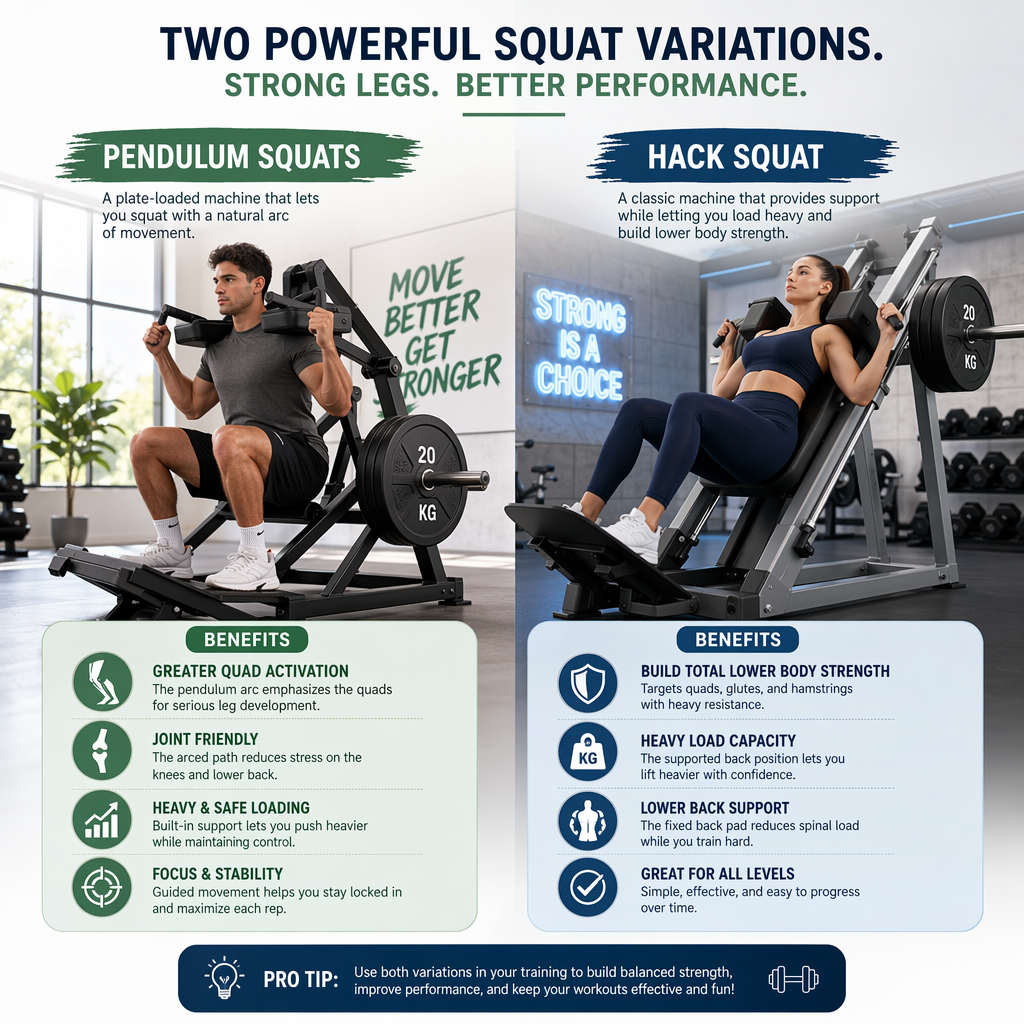
The pendulum squat offers a few clear advantages over the hack squat, especially if you want more versatility and a deeper feel at the bottom. Many lifters use it for muscle growth because the arc can create a strong quad-focused training effect during deep knee flexion.
It also tends to feel friendly on the lower back while still supporting hard strength training. In some setups, the machine can do more than one job, which adds value for leg workouts. If proper form and exercise variety matter to you, the pendulum squat becomes very appealing.
Muscle Growth Potential and Hypertrophy
If your main goal is muscle growth, the pendulum squat has a strong case. Its arc and deep squat feel can place greater emphasis on the quads through a long working range. That can make the exercise very effective for hypertrophy in the front of the thighs.
The hack squat is still excellent for leg muscles and can often be loaded heavily. In fact, many lifters can handle heavier weights on a hack squat because the track is so fixed and stable. So for pure loading, the hack squat may win. For targeted tension, the pendulum squat often stands out.
Why the pendulum squat works well for hypertrophy:
- It creates strong quad-focused tension for muscle growth.
- It often allows a deep working range for the leg muscles.
- It still supports progressive overload while keeping form controlled.
Lower Back and Knee Impact
One of the biggest benefits of both machines is reduced spinal loading compared with barbell squat training. That matters if your lower back gets tired before your legs do, or if you have past back issues and want a more supported way to build leg strength.
The pendulum squat is often praised for being especially friendly on the back because the path helps stabilize your torso. The hack squat also keeps lower back demand low with strong back support. In either case, proper alignment is still essential if you want to reduce the risk of injury.
As for the knees, the answer is not the same for everyone. Some lifters find the pendulum squat more comfortable because the arc distributes stress differently through knee flexion. Others do well on a hack squat. Your setup, stance, and control usually matter more than the machine name alone.
Benefits and Drawbacks of the Hack Squat
The hack squat is popular for a reason. It is simple to use, easy to load, and effective for strength training focused on the quads, which are the primary muscle group. Many lifters use it to build leg size without the balance demands that come with free weights.
Still, it has trade-offs. Compared with a pendulum squat or even a leg press hack squat combo, exercise variety is limited. It is also more common in commercial gyms than home setups. For some users, deep knee flexion on a fixed track may feel less natural than an arc.
Strength and Size Progression for Legs
The hack squat is excellent for building leg strength and adding size over time. Because the machine is stable and easy to load, it works well for progressive overload. Many experienced lifters and advanced lifters use it when they want a hard quad-focused set without worrying about bar balance.
It also suits people who want straightforward leg development. The machine keeps the rep path consistent, so you can focus on effort and depth. If your goal is moving heavier loads safely, the hack squat often has an advantage over the pendulum squat.
Why lifters like it for progression:
- Hack squat targets the quads with a clear, repeatable pattern.
- The machine makes progressive overload simple to track.
- Advanced lifters can push heavy sets with lower balance demands.
- Joint Stress, Safety, and Accessibility
Safety is one reason the hack squat stays popular. The guided sled and back pad help control the rep, which can lower the chance of sloppy form when fatigue sets in. It also keeps the lower back in a supporting role instead of making it the weak link.
Even so, joint stress depends heavily on proper setup. If your feet are in the wrong spot or your depth is forced, the movement can feel rough on the knees. The machine is safe, but it is not automatic. You still need control and a stance that fits your body.
A few accessibility points matter too:
- Hack squats are common in commercial gyms.
- They are less common in a small home gym.
- Some models offer little exercise variety beyond squats.
- Good setup is essential for comfort and safety.
Pendulum Squat vs Hack Squat: Choosing for Specific Goals
The better machine depends on your training goals, not just on which one feels harder. If you want focused quad work, smoother mechanics, and more exercise options, the pendulum squat can be the ideal choice. If you want a direct, heavy, no-frills lower-body machine, the hack squat fits well.
Your fitness goals, body structure, and available space should guide the decision. Proper technique matters on both, but the right movement pattern for you can make leg exercises safer and more productive. Let’s narrow it down for beginners and for home gym buyers.
Best Choice for Beginners and Learning Proper Form
For a beginner, both machines can work well because they guide the motion and reduce balance demands. That makes learning proper form easier than with many free-weight squat variations. You can focus on your feet, knee tracking, and depth without also managing a bar on your back.
The hack squat often feels more intuitive at first. Its fixed track and firm back support make proper technique easier to understand from the first session. A beginner who wants a simple start may find that reassuring.
Still, the pendulum squat is also beginner-friendly, especially for someone who wants more variety in one machine. It can support leg development beyond basic squats through options like lunges, split squats, and calf work on some models. So the better beginner pick depends on whether you value simplicity or versatility.
Which Machine is More Suitable for Home Gyms?
If you are shopping for a home gym, the pendulum squat often makes more sense. The key reason is versatility. Some pendulum machines can handle more than one exercise, which gives you better use of limited space. That matters when every piece of equipment needs to earn its footprint.
The hack squat is still a strong option, but it is more specialized. In commercial gyms, that is not a problem because there is room for single-purpose machines. At home, a machine that mostly does one thing may be harder to justify unless quad training is your top priority.
Why the pendulum squat often wins for home use:
- Better accessibility when you want more than one exercise from a squat machine
- More useful in tight spaces than a dedicated single-purpose unit
- A leg press hack squat combo can help, but standard hack units are still less versatile
Conclusion
In summary, both pendulum squats and hack squats offer unique benefits tailored to different fitness goals. While pendulum squats excel in providing a greater range of motion and lower back safety, hack squats are celebrated for their effectiveness in building leg strength and size. Choosing between the two ultimately depends on your specific objectives, experience level, and equipment availability. By understanding these differences, you can make an informed decision to enhance your workout routine. If you're ready to take your fitness to the next level, don’t hesitate to reach out for personalized guidance tailored to your needs!
Frequently Asked Questions
Are Pendulum Squats or Hack Squats Better for Quad Activation?
The pendulum squat often has a slight advantage for quad-focused muscle activation because of its arc and deep working range. The hack squat still trains the quads very well, especially with lower foot placement. Both are effective lower-body tools, but the pendulum squat may feel more quad-dominant.
Is One Safer on the Knees Than the Other?
Neither machine is automatically safer for every person. Some lifters find the pendulum squat more comfortable during deep knee flexion, while others prefer the hack squat’s fixed track. Proper technique, stance, and machine setup matter most when building lower body strength without irritating the knees.
Can You Combine Pendulum and Hack Squats in a Routine?
Yes, you can use both in one workout routine if recovery and volume are managed well. A pendulum squat and hack squat challenge overlapping muscle groups with slightly different movement patterns, so combining them can add variety and make your leg workouts more complete.
REFERENCE:
https://uchinogym.com/en/collections/rep-fitness
https://pubmed.ncbi.nlm.nih.gov/28704312/
https://stamped.io/go/d3xXaWRnZXRTaWRlRHJhd2VyfDMzMDU0M3xyfDEzOTg0ODUzMA2
https://stamped.io/go/d3xXaWRnZXRTaWRlRHJhd2VyfDMzMDU0M3xyfDE2MjE3MjIzOQ2