

Key Highlights
- A pendulum squat is a machine-based squat that guides your movement for stable, full-range reps with less need for balance than free weights.
- If you don't have a pendulum squat machine, try alternatives like goblet squats, hack squats, or safety bar squats with free weights. These exercises also promote a full range of motion and challenge your muscles differently.
- It helps you train through a full range of motion with less balance demand than free weights.
- The squat machine places strong emphasis on your quads while still training other lower body muscles.
- Many lifters use it for muscle growth because it creates constant tension across each rep.
- It can support lower body strength without the same spinal loading as a back squat.
- Proper setup and foot position make a big difference in comfort and results.
Introduction
If you want a lower body exercise that feels stable, challenging, and easy to learn, the pendulum squat is worth your attention. This squat variation has become popular in strength training because it lets you push hard without worrying as much about balance or heavy spinal stress.
This results in lower reps, increased emphasis on the quads, and greater assurance for leg day among numerous lifters. So, what sets it apart, and what's the best way to incorporate it? Let's explain it clearly.
what is a pendulum squat
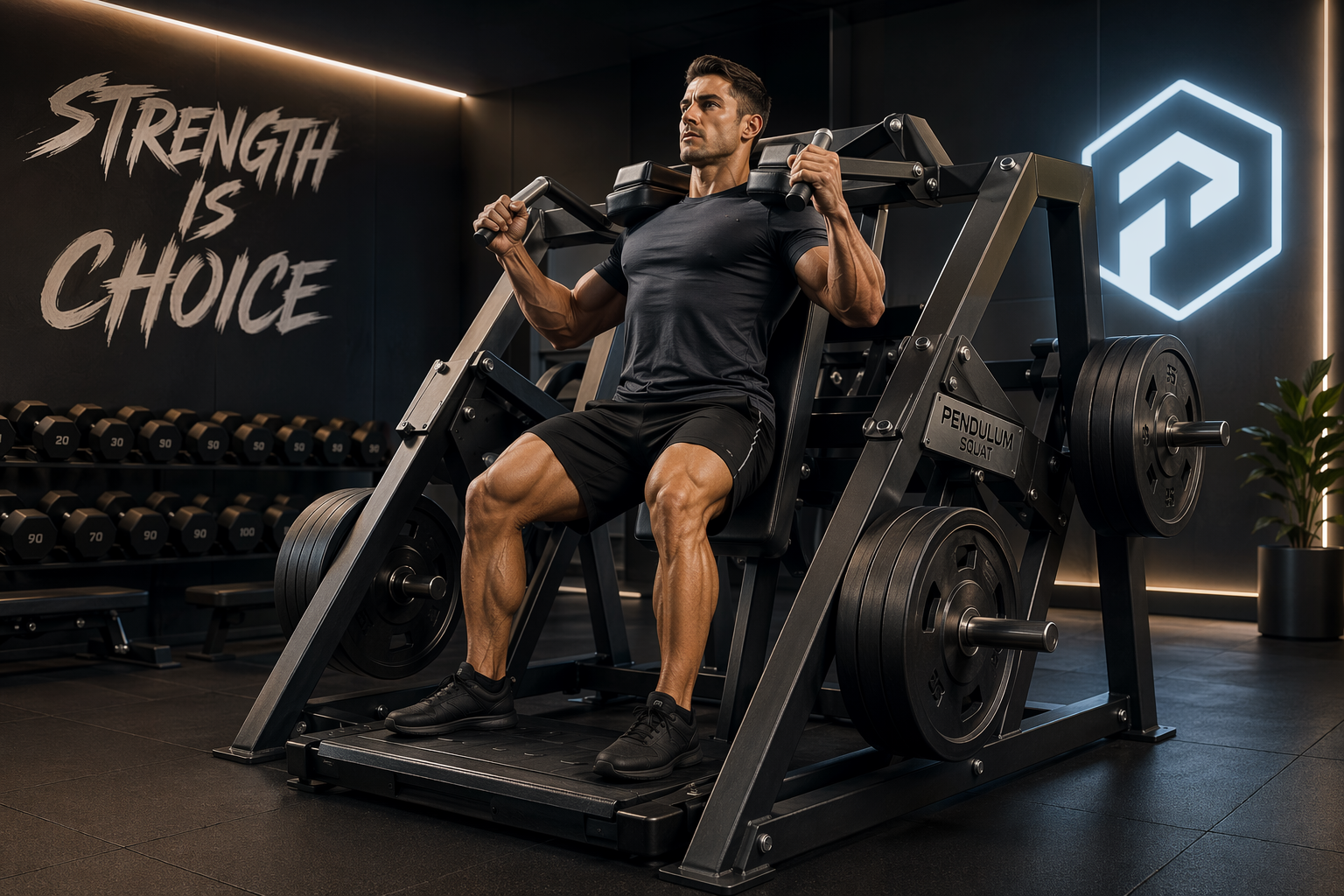
A pendulum squat is a machine-based squat variation where the load moves on a fixed, arcing movement path. Instead of supporting a bar across your upper body like a barbell squat, you brace against pads and squat within the machine. That setup makes the lift feel more controlled and more repeatable from rep to rep.
What makes the pendulum squat stand out is how it combines deep knee bend, constant tension, and easier balance.
By maintaining correct form, you’ll be able to concentrate on pushing with your legs rather than worrying about keeping the load steady.
Compared with a regular squat, the machine handles much of the balance work for you. That often makes it more beginner-friendly, especially if you want hard leg training without the same technical demand as traditional squat patterns.
How a Pendulum Squat Differs from Traditional Squats
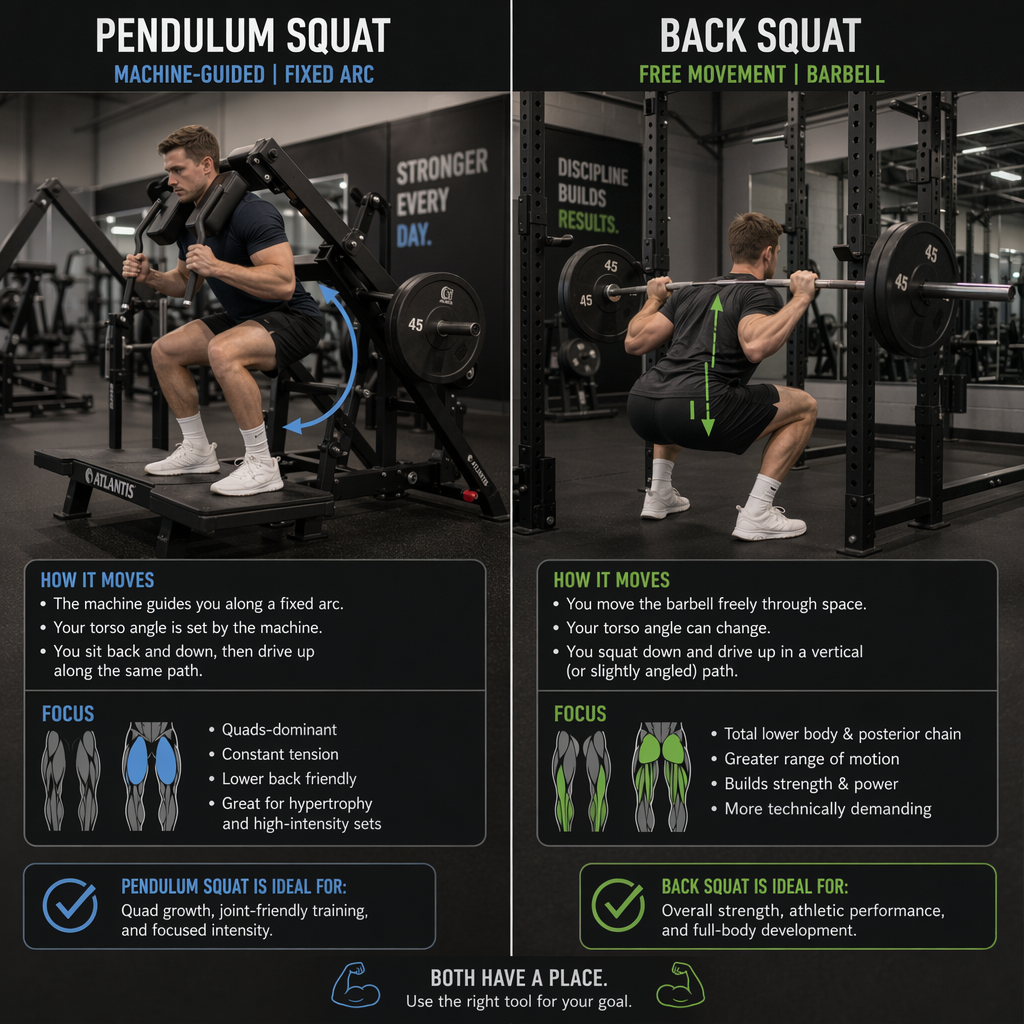
The biggest difference between a pendulum squat and a traditional squat is stability. In a barbell squat or back squat, you control the bar, your balance, and your torso position all at once. On a machine, the path is guided, so you can focus more directly on pushing through the rep.
That changes the training feel in useful ways. A pendulum squat usually feels more quad-dominant, while a traditional squat spreads work across more muscle groups and stabilizers.
- Pendulum squat: guided path, less balance demand, less spinal loading
- Barbell squat: more coordination, more core involvement, more technical skill
- Traditional squat: greater carryover to full-body strength and technical lifts
Another key difference is consistency. The machine helps you hit similar depth and rep quality each time. For many people, that makes solo training feel safer and more manageable, especially during hard leg sessions.
(ALSO READ: Master the Back Barbell Squat: A Beginner's Guide)
Key Features of the Pendulum Squat Machine
A pendulum squat machine is built to guide you through a fixed squat pattern while keeping your back and hips supported. That design helps you move with more control and usually makes it easier to reach a deep range of motion. If balance limits your free-weight squats, this can be a big advantage.
Another standout feature is the resistance curve. Many machines feel harder at specific points in the rep, and some designs even shift load so the bottom feels lighter and the top feels heavier. That creates a different training effect than many other leg machines.
|
Feature |
What It Does |
|---|---|
|
Fixed movement path |
Guides the squat and reduces balance demands |
|
Back and shoulder pads |
Improve support and setup stability |
|
Deep range of motion |
Helps you squat lower with consistency |
|
Resistance curve |
Changes how hard the rep feels across the lift |
For many lifters, those features mean safer solo work, steady rep quality, and strong quad focus without the complexity of free weights.
Muscles Worked by the Pendulum Squat
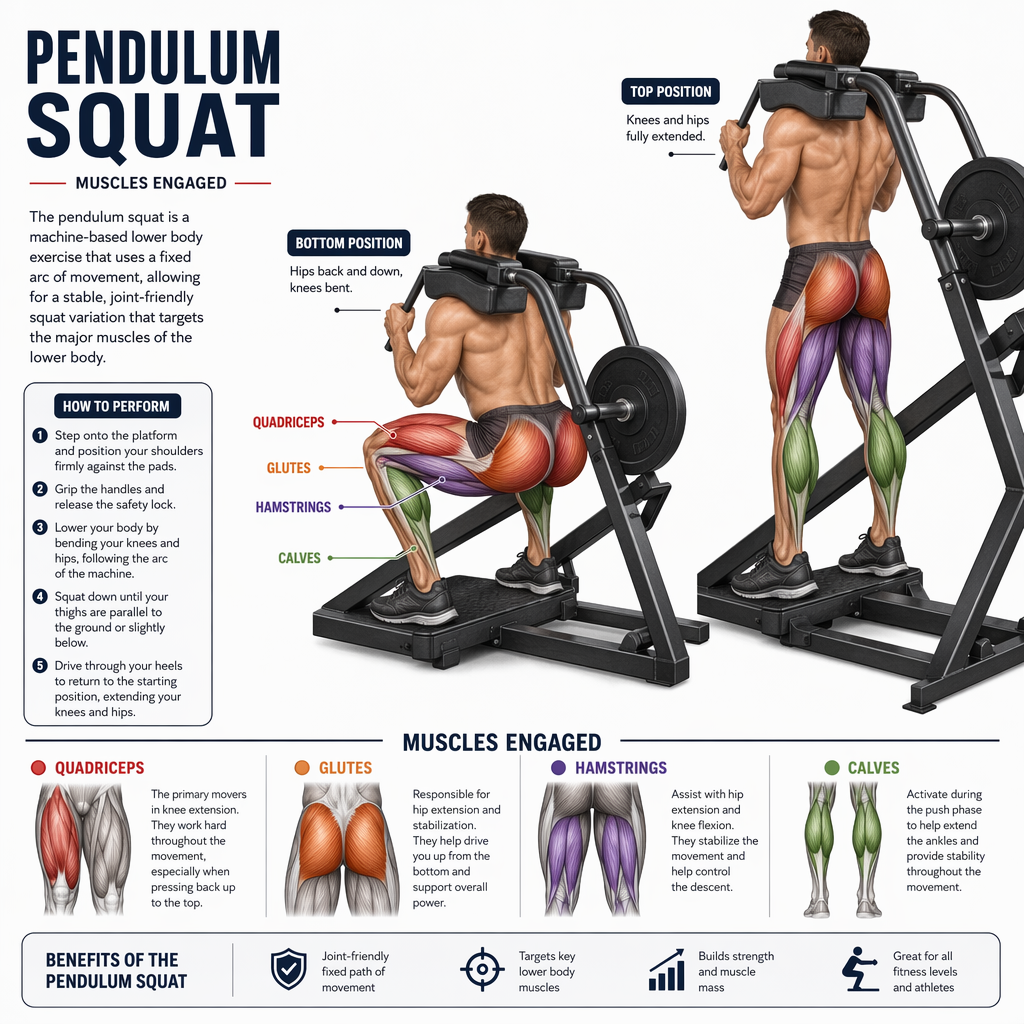
The pendulum squat trains several major muscle groups in your lower body. The main leg muscles involved are the quadriceps, glutes, and hamstrings, with the calves helping to a lesser degree. Because of the machine setup, many people feel the quads working especially hard from the first few reps.
That strong quad bias is one reason the exercise is popular for lower body strength and size. Even though the pendulum squat is machine-based, it still gives you a serious training effect when your goal is productive leg work.
Primary Muscle Activation and Benefits for Strength
If your goal is quad growth, this exercise deserves a place in your program. The pendulum squat works the quadriceps hard, especially the vastus medialis, vastus lateralis, vastus intermedius, and rectus femoris. Because the machine supports you and allows deep reps, tension stays on the front of your thighs for a large part of the set.
You also train the gluteus maximus and hamstrings, particularly as you drive out of the bottom. That said, the overall feel is usually more quad-focused than many free-weight options. This is why so many lifters use it during hypertrophy blocks.
Compared with a hack squat, the pendulum squat offers similar benefits for building quads without much spinal stress. Both are strong choices, but the pendulum squat often stands out for its deep motion, fixed path, and hard tension at key points in the rep.
Secondary Muscles Engaged During Each Rep
Even though the pendulum squat is not as demanding on stabilizers as a barbell squat, secondary muscles still contribute during every rep. Your torso has to stay braced against the pads, and that calls on core strength to help keep your body position steady as you lower and drive upward.
Your lower back and upper back are involved too, though not in the same loaded way as with free weights. The machine reduces spinal loading, but those areas still help you stay organized and controlled throughout the set.
Secondary support often comes from:
- Core muscles that help maintain trunk stiffness
- Upper back muscles that help keep your chest and shoulders set
- Muscles involved in hip extension as you stand back up
So while the quads get most of the attention, the lift still asks your body to work together.
(ALSO READ: 7 Effective Barbell Back Squat Alternatives to Try Toda)
Proper Form and Technique for Pendulum Squats
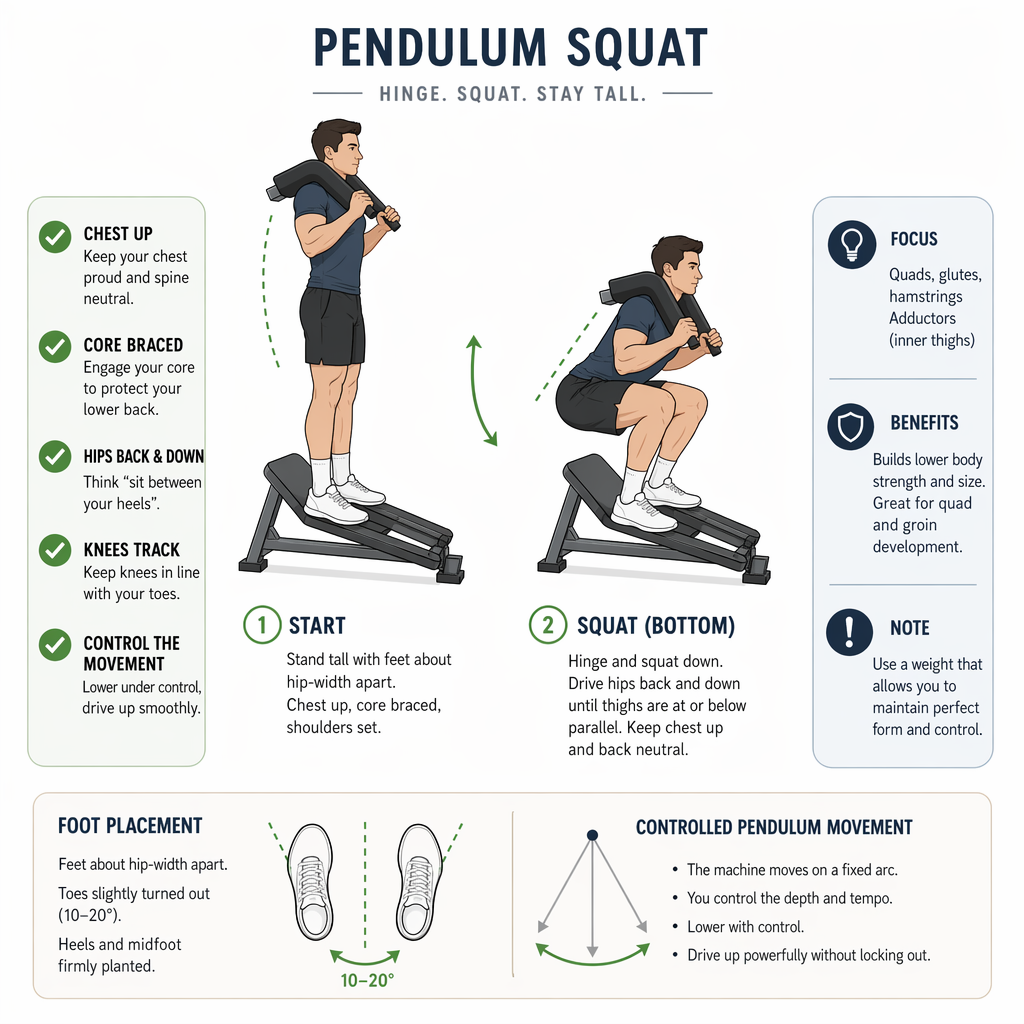
Good results with this exercise come from proper form, not just loading more plates. The squat machine makes the movement pattern easier to learn than many technical lifts, but setup still matters. Small mistakes in stance, bracing, or depth can change how the rep feels.
Once you understand the basics, the pendulum squat becomes much more effective and comfortable. The next two sections cover how to set up the lift correctly and which errors can throw off your reps.
Step-by-Step Setup and Execution
Start by loading the machine and getting into a solid starting position. Place your back and hips against the pad, set your shoulders under the shoulder pads, and put your feet about shoulder-width apart on the platform. A slight toe-out foot position often feels natural. Then hold the handles and unlock the machine.
Before you descend, take a deep breath into your stomach and brace. Keep your back and hips pressed into the pad as you bend your knees and lower yourself. Aim for a comfortable range of motion, ideally deep enough that your calves and hamstrings come close together.
Use this checklist:
- Set a stable foot position on the platform
- Brace with a deep breath before each rep
- Lower under control through your available range of motion
- Drive through your feet to return to the top
For safe execution of pendulum squats, you’ll require a pendulum squat machine along with properly loaded weight plates if the equipment is plate-loaded.
Common Technique Mistakes to Avoid
A common mistake is assuming the machine does all the work for you. It helps guide the rep, but proper form still matters. If you rush the descent, lose your brace, or shift around on the pads, the exercise becomes less effective and can feel rough on the knee joint.
Another issue is choosing too much weight too soon. Many lifters underestimate how challenging the resistance curve can feel, even with lighter loads. Some pendulum squat machines also have a high starting resistance, so your first order of business should be learning the machine, not chasing plates.
Watch out for these mistakes:
- Letting your body come loose from the pads
- Using more weight than you can control cleanly
- Ignoring how the machine’s resistance curve changes the rep
The goal is hard training with control, not sloppy reps that defeat the point of reduced spinal loading.
Conclusion
In conclusion, the pendulum squat is a versatile and effective exercise that can enhance your leg strength while minimizing the risk of injury. By focusing on proper form and understanding the unique benefits it offers compared to traditional squats, you’ll be well-equipped to incorporate this movement into your fitness routine. Remember, mastering the setup and execution is crucial for reaping the full benefits of the pendulum squat. If you have any questions or would like personalized guidance, feel free to reach out and get a free consultation with our fitness experts!
Frequently Asked Questions
Is the pendulum squat more challenging than other leg exercises?
Yes, it can feel tougher than other leg day machines, especially on your quads. The pendulum squat removes balance limits, so your legs do more of the work. Its resistance curve can also make lighter weights feel surprisingly demanding, much like a hard set on a hack squat machine.
REFERENCE:
https://pubmed.ncbi.nlm.nih.gov/33440446/
https://doi.org/10.1519/JSC.0b013e31824ede62
https://doi.org/10.1249/MSS.0000000000003271