

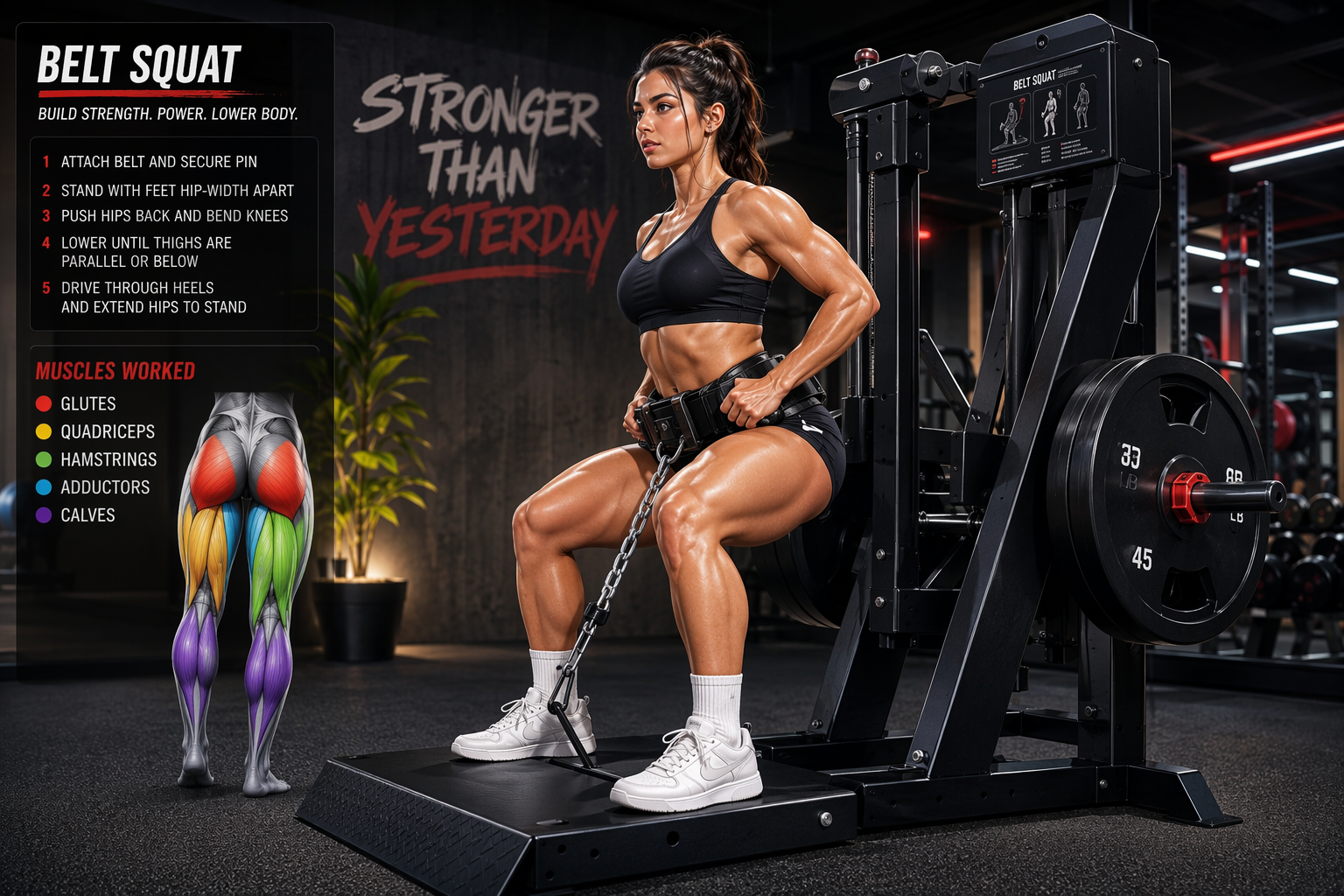
Key Highlights
- The belt squat mainly targets your quads, with strong help from your glutes and hamstrings.
- It trains several lower-body muscle groups while placing far less stress on your lower back than a barbell squat.
- Because the load sits around your pelvis, you can focus on leg strength training with better posture and proper form.
- Your adductors, calves, and hip flexors also assist each rep.
- An elevated platform setup can increase range of motion.
- Compared with a back squat, it uses less trunk involvement and more direct leg focus.
Introduction
If you want a squat variation that builds your legs without loading your spine, the belt squat deserves a close look. It is a smart strength training option for lifters who want to challenge key muscle groups while giving the back a break. Instead of placing weight on your shoulders, the resistance hangs from a belt at the hips. That simple change shifts the work toward your legs and hips. So, what exactly does the belt squat train, and why do so many people add it to their routine?
(ALSO READ: Belt Squat Exercises: Build Strength and Power Today)
Belt Squat Muscles Worked
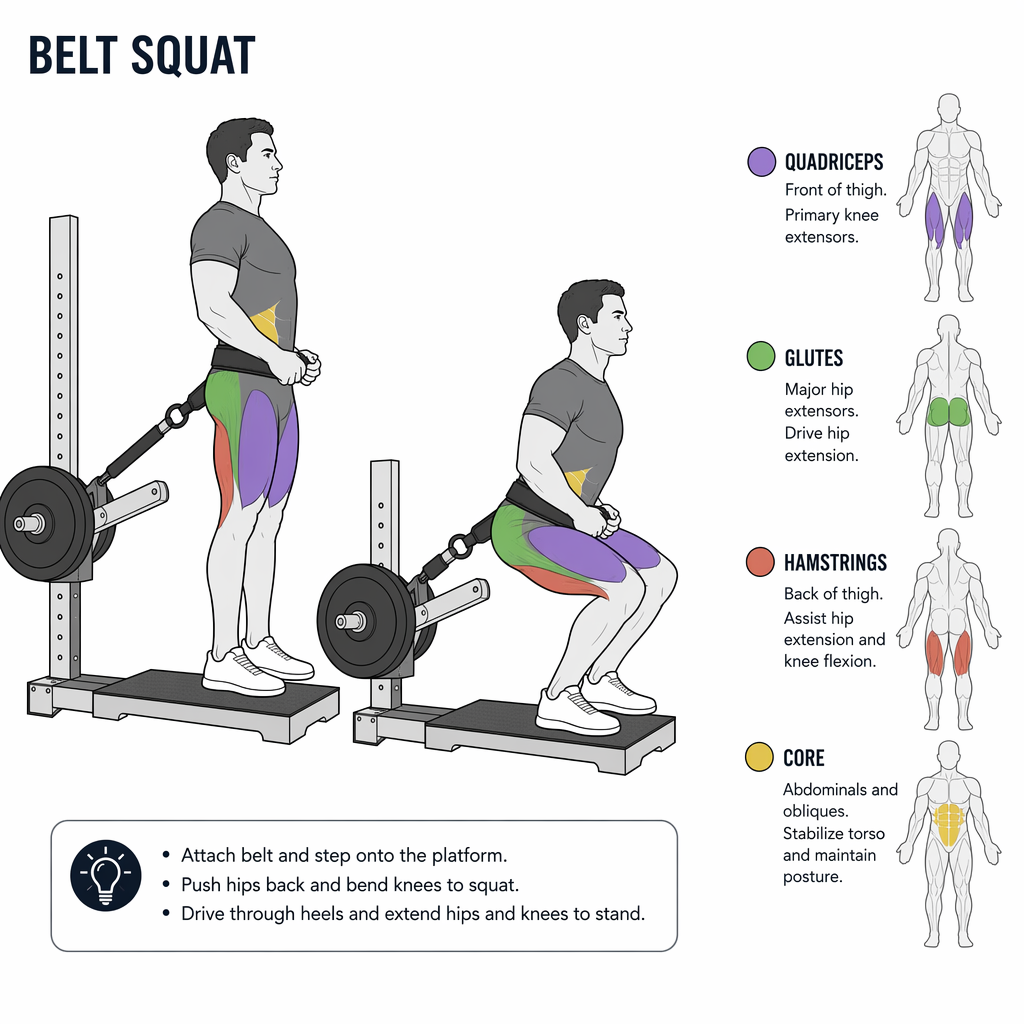
The belt squat works several lower-body muscle groups, but your quads do most of the lifting. As you stand up from the bottom, your knees extend, and the quads take the lead. Your hamstrings and glutes then assist with hip drive and help you finish the movement smoothly.
Beyond those big movers, your adductors help keep your knees tracking well, while your calves support foot pressure and balance. The hip flexors also handle extra demand because the load hangs from the hips. If you are asking whether the belt squat hits glutes, quads, or hamstrings most, the clearest answer is the quads.
(ALSO READ: Belt Squat Benefits: A Game Changer for Lower Body)
Targeting the Quads, Glutes, and Hamstrings
For most lifters, the belt squat emphasizes the quads first. That is because the load drops from the pelvis and keeps the challenge centered on the legs instead of the torso. The glutes and hamstrings still work, but they are not usually asked to do as much as they would in a back squat. The gluteus maximus helps with hip extension, especially as you rise from the bottom.
A few setup details can change the feel of each rep. If you use an elevated platform, you can lower deeper and increase leg demand. Good posture matters too. Stand tall, brace before each rep, and keep proper form from start to finish.
- A stance between hip and shoulder width usually gives balanced quad and glute work.
- Toes can turn slightly outward if that feels natural.
- Different stance widths can emphasize different hip muscles.
- Push evenly through your feet to keep hamstrings and glutes involved.
Core Activation and Hip Engagement
The belt squat does activate your core, but not like a traditional back squat. Because there is no load across your upper body, your trunk does not have to fight as hard to stabilize a bar. You still need to brace, though. A solid brace helps you stay balanced and keeps the movement controlled.
One of the main benefits of this lift is that it activates your hips effectively; because the resistance is suspended from your pelvis, your hip flexors experience a more concentrated load compared to most other squat types. Your adductors play a supportive role during both the descent and ascent, aiding knee alignment and contributing to improved lower-body stability.
That makes the belt squat effective for building hip strength, especially when proper form stays sharp. It can also feel friendlier on the lower back while still training the muscles that support strong, stable movement.
Belt Squat Benefits for Leg and Hip Strength
One big benefit of the belt squat is direct leg strength work with less spinal loading. That means you can train major muscle groups like the quads, glutes, and hamstrings hard while keeping your back fresher. Many lifters also recover faster after belt squat sessions.
For beginners, that can make the exercise a useful entry point for lower-body strength training. Trainers often recommend it when you want to build your legs, improve hip flexors and glutes, or keep training even when back stress needs to stay low. To see why, it helps to compare it with the back squat.
Differences from Back Squat and Stress on Lower Back
The most significant distinction lies in the location of the weight. In a back squat, a barbell rests on your upper back, so your trunk, abs, and spinal muscles must work hard to support it. In a belt squat, the load hangs from your hips. That shifts more of the challenge to the legs and reduces stress on the lower back.
Here is a simple comparison:
|
Feature |
Belt Squat |
Back Squat |
|---|---|---|
|
Load position |
Around the hips |
Across the upper back with a barbell |
|
Main focus |
Legs, especially quads and hamstrings |
Legs plus trunk and glutes |
|
Lower back stress |
Lower |
Higher |
|
Recovery demand |
Usually easier |
Usually harder |
|
Setup |
Machine or elevated platform |
Rack and barbell |
If you are asking which is less stressful, the belt squat clearly is. It also helps you keep posture and proper form without the same spinal demand. The back squat still trains more total muscle groups, but the belt squat is often better when leg focus matters most.
Conclusion
In conclusion, the belt squat is an exceptional exercise that effectively targets your quads, glutes, and hamstrings while also engaging your core. This unique approach not only enhances your leg and hip strength but also alleviates stress on your lower back compared to traditional squats. By incorporating belt squats into your workout routine, you're setting yourself up for improved athletic performance and overall strength gains. So, lace up those shoes, grab your belt squat apparatus, and get ready to elevate your fitness journey! You’re welcome to contact us for a complimentary consultation if you have questions or would like tailored assistance
(ALSO READ: Belt Squat Alternatives: 10 Variations to Try Today)
Experiences with belt squats versus back squats?
Belt squats primarily target the quadriceps, glutes, and hamstrings while minimizing spinal loading. In contrast, back squats engage multiple muscle groups, including the lower back and core. Users often report less strain on their lower back with belt squats, making them a safer alternative for those with back issues.
REFERENCE: