

Key Highlights
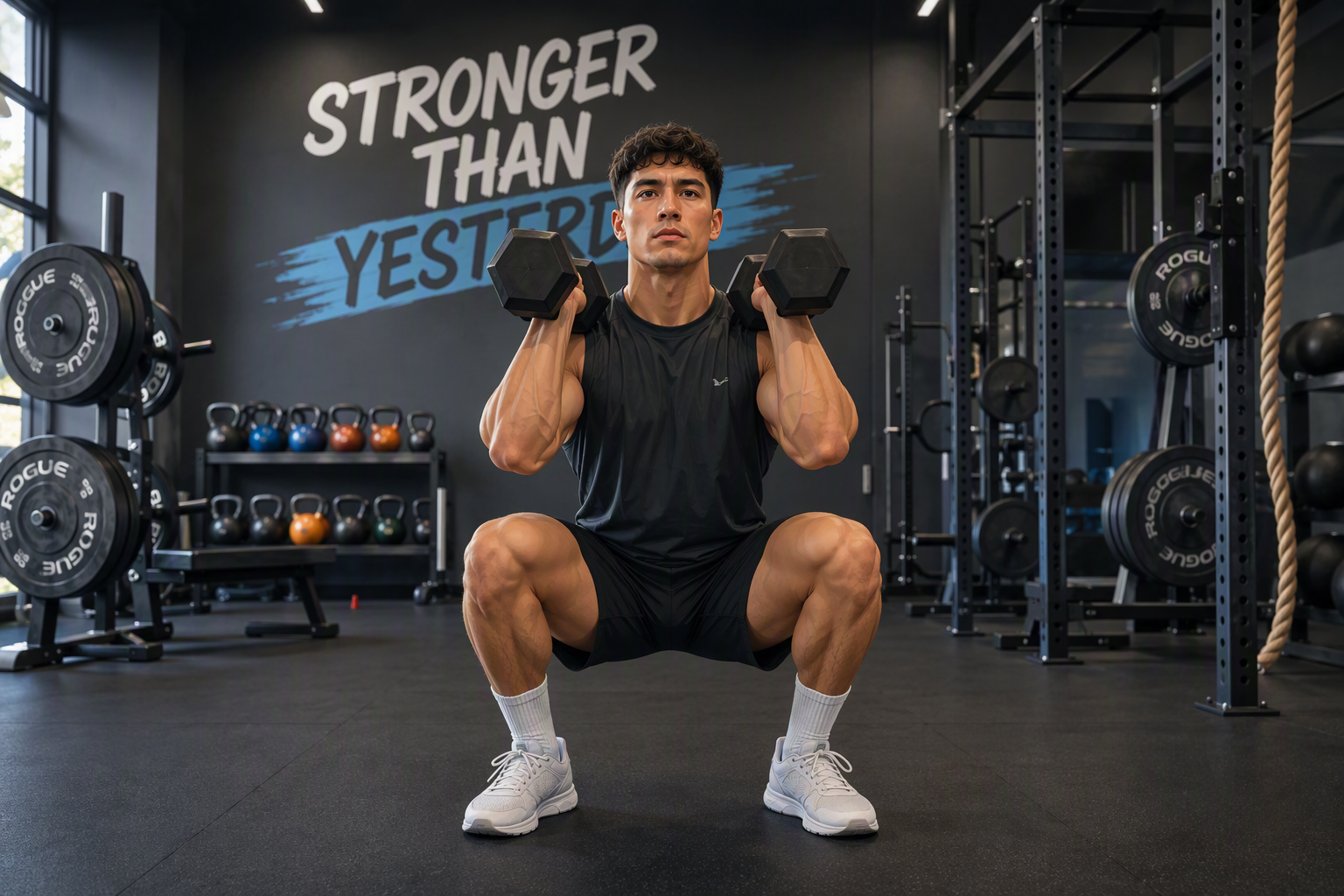
- The dumbbell front squat is a simple squat exercise that needs a pair of dumbbells and minimal floor space. Using proper form helps you keep an upright torso position and improves muscle activation.
- For beginners, it is recommended to start with a pair of dumbbells weighing 10-20 pounds each for the front squat. This allows you to focus on maintaining an upright torso and proper form without risking injury.
- Using proper form helps you keep an upright torso position and improves muscle activation.
- This front squat builds lower body strength in your quads, glutes, and hamstrings.] Your core, upper back, and shoulders also work hard to stabilize the front rack. Common mistakes like dropping your elbows or performing shallow squats reduce the benefits of squats and can stress your lower back.
- For best results, you can include dumbbell front squats in your training routine 1–3 times per week, depending on your overall workout program, goals, and recovery needs. This frequency helps develop lower body strength while giving your muscles enough time to recover.
- Your core, upper back, and shoulders also work hard to stabilize the front rack.
- Common mistakes like dropping your elbows or performing shallow squats reduce the benefits of squats and can stress your lower back.
- It is a great option for home workouts and beginners.
Introduction
The dumbbell front squat is one of the most practical moves you can add to your squat training. It helps with building muscle, promotes higher rep performance, improves lower body strength, and does not require a squat rack or much floor space. That makes it a smart fit for almost any fitness journey. If you have wondered how to perform a dumbbell front squat with proper form, the answer starts with setup, control, and keeping the weight steady on the front of your body.
CLICK HERE
Mastering Dumbbell Front Squat Form
Good front squat form matters because the setup, including barbell placement, affects everything that follows. When your rack position is solid, you can stay balanced, protect your lower back, and train the right muscle groups. When it comes to strength standards for dumbbell front squats, they can vary based on fitness level and body weight. Generally, beginners may aim for dumbbells totaling 40–60% of their body weight, while intermediate to advanced athletes can work toward 70–100% of body weight. It's important to prioritize form as you increase weight.
(ALSO READ: Front Squat Exercise: Key Form Tips for Success)
Unlike a barbell squat, you do not need a squat rack to get started. Still, your starting position, elbow angle, and body posture must be right. The next sections break down exactly how to set up and move through each rep with proper form.
Proper Set-Up and Starting Position
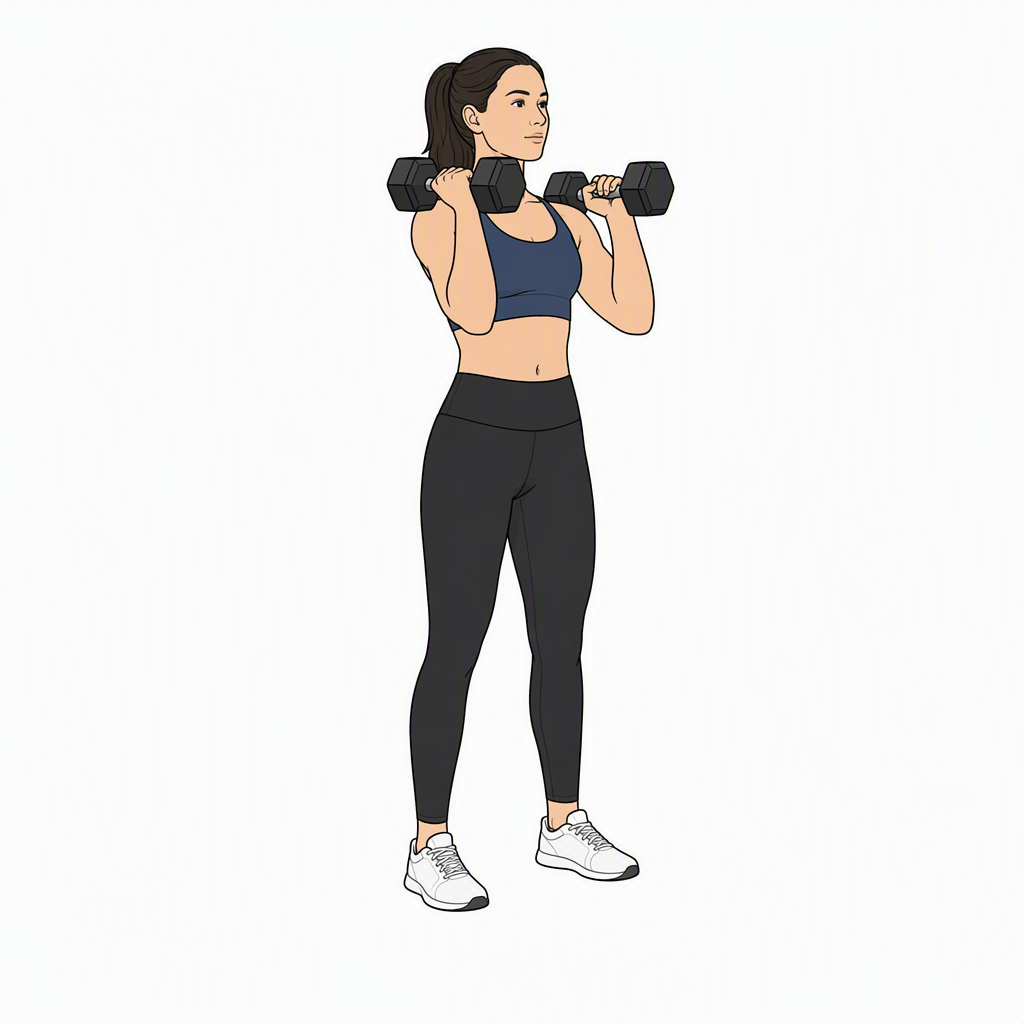
Begin by gripping a set of dumbbells in your hands at your sides. If the weights are light, curl them to shoulder height. If they are heavier, use a clean to bring them up. Rest the ends closest to your thumbs on the front of your shoulders.
From there, create your front rack position. Keep your elbows up and slightly forward so the dumbbells stay stable. Your feet should be around hip-width, with your posture tall and your eyes forward. This starting position helps place the load on the front of your body.
A common mistake is letting the weights drift too low or keeping the elbows down. That makes the rack position weak and pulls your chest forward. You do not need a squat rack here, but you do need control before every rep.
Step-by-Step Movement Breakdown
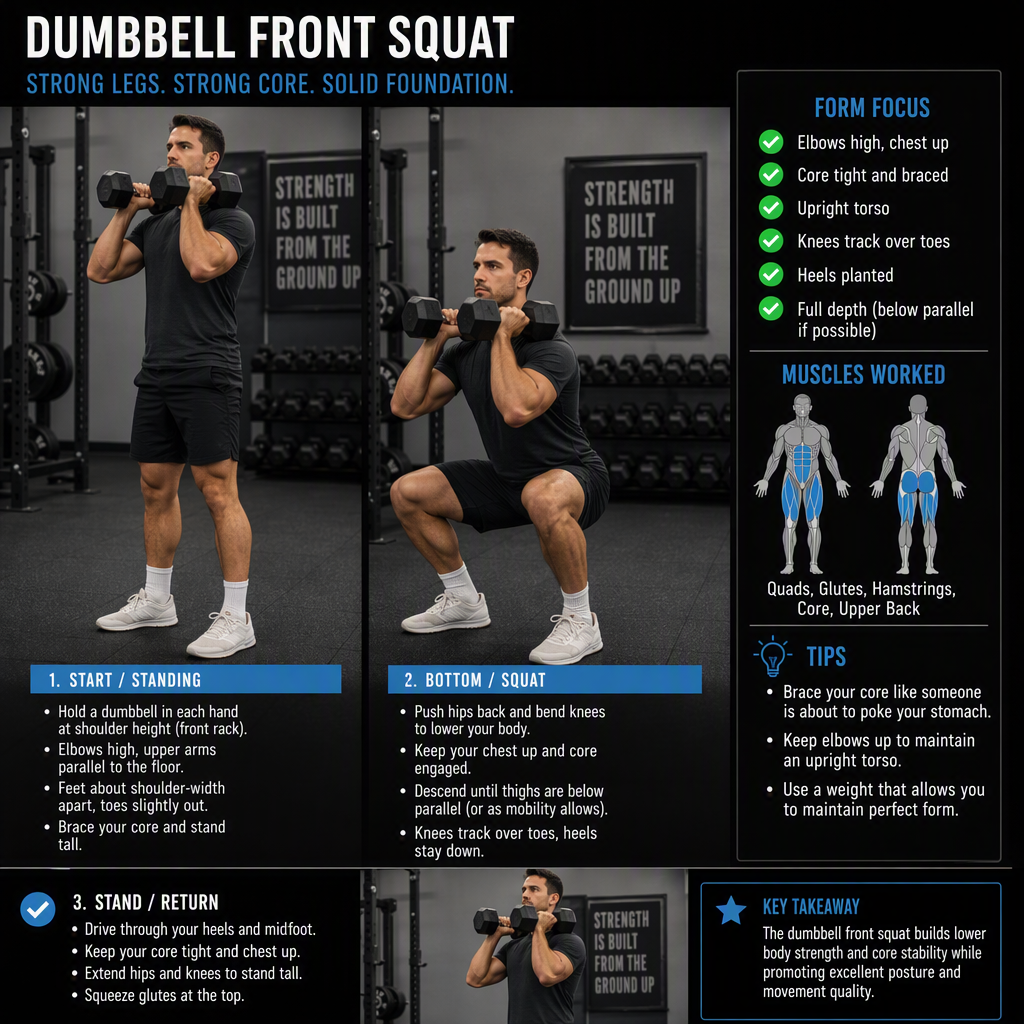
Once you are set, think about moving straight down instead of folding over. The goal is clean squat form that keeps your chest up and your torso tall. That is what makes this front squat safe and effective.
Follow these steps:
- Hold the dumbbells in the front rack and brace before you move.
- Sit straight down while pushing your knees out in line with your toes.
- Lower until your hip crease drops slightly below the top of your knees.
- Drive back up to standing and reset before the next rep.
During front squat workouts, avoid rushing. A smooth descent and strong return improve muscle activity through the lower body and core. This squat exercise works best when each rep looks nearly the same from start to finish.
Breathing and Bracing Techniques
Before each rep, take a deep breath and brace your core as if you are about to take a punch. This is one of the most useful bracing techniques for keeping your spine stable under load.
That brace helps support your lower back while you squat. It also makes it easier to hold an upright torso position when the dumbbells sit on the front of your shoulders. If you relax your midsection, your chest will often drop, and the rep becomes less stable.
Try to inhale before descending, stay tight through the bottom, and exhale as you rise or once you pass the hardest part. Good breathing improves control, keeps your torso organized, and can help you manage more weight without losing position.
Frequent Errors to Steer Clear of While Performing the Dumbbell Front Squat
Most problems with dumbbell front squat variations come from losing position. Poor squat form usually shows up as excessive forward lean, dropping elbows, or shallow squats. These errors often start with weak setup, rushed reps, or weights that are too hard to control.
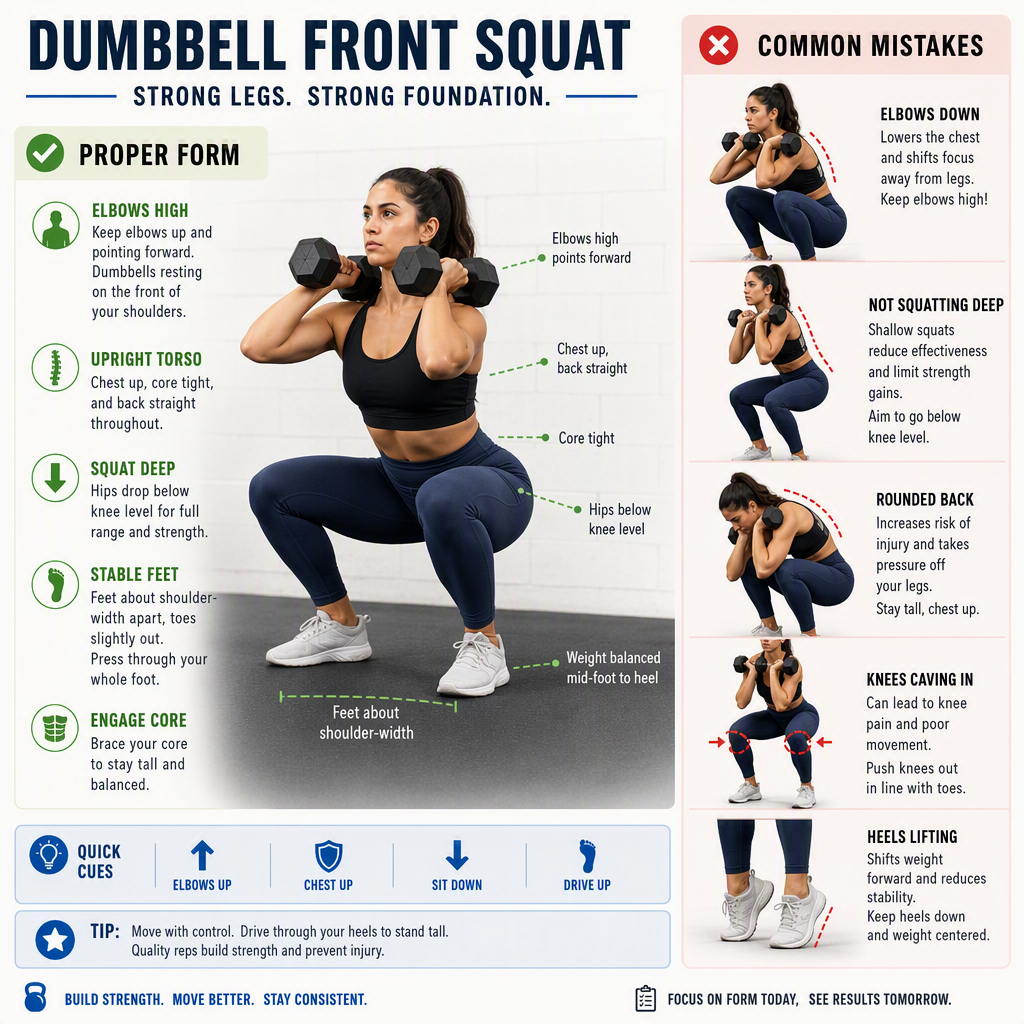
When that happens, the exercise shifts away from the target muscle groups and places more stress on areas like the lower back. The next two sections cover the biggest mistakes and how you can fix them quickly.
Dropping Elbows or Chest Forward
Dropping elbows usually happens when the dumbbells are not secure in the rack or when your upper back loses tension. Once that happens, your chest forward angle increases and the front squat becomes harder to control.
That change can cause several problems:
- It reduces your upright torso position and shifts effort away from your legs.
- It can increase strain on the lower back and lead to back issues over time.
- It makes the dumbbells feel heavier because the load moves away from your center.
Keep your eyes facing forward and raise your elbows prior to each repetition to correct the issue. Think about showing the logo on your shirt to the wall in front of you. If needed, use lighter weights until your upper back can hold the position without drifting.
Shallow Squats and Insufficient Depth
Shallow squats limit what this exercise can do for you. If you stop too high, you reduce squat depth and miss some of the muscle activation that helps build the lower body, as noted in the European Journal of Applied Physiology. That also affects how much work your quads and glutes actually do.
A better target is to lower until your hip crease is slightly below your knees. That depth lines up with the standard movement described for the dumbbell front squat. It keeps the rep honest and gives the lower body a fuller training effect.
If shallow squats become a habit, progress can stall. The effects of squat training on lower limb muscle volumes respond better when you train through a meaningful range of motion. If depth is hard to reach, reduce the load and focus on clean reps first.
Benefits of Incorporating Dumbbell Front Squats in Your Routine
The front squat benefits are easy to appreciate. This move builds lower body strength, trains your core and upper back, and fits well into almost any strength training plan. Additionally, the front squat places significant emphasis on proper form, making it simpler to learn than many barbell squat variations.
Another plus is accessibility. You only need dumbbells and a bit of floor space, so it works well at home or in a busy gym, which is something that bean counters appreciate. Next, let’s look at the specific muscle and movement benefits in more detail.
Strengthening Lower Body and Core Muscles
Yes, dumbbell front squats can help increase leg strength and mass. They train the lower body directly while also challenging your core muscles to keep you stable. That combination makes them effective for building muscle without needing to worry about how much weight is used in a barbell front squat setup.
The main training effects include:
- Stronger quads, glutes, and hamstrings through repeated loaded squatting, as investigated in the Journal of Sport Rehabilitation.
- Better core muscle engagement as you resist folding forward.
- More total muscle activity because the shoulders and back help hold the dumbbells in place.
This is one reason the exercise works so well for beginners and experienced lifters alike. You strengthen major body muscles at once, and the front-loaded position teaches you how to stay balanced under tension.
(ALSO READ: Discover the Benefits of Front Squats for Strength Gains)
Enhancing Posture and Functional Movement
Dumbbell front squats are effective for enhancing posture because the load sits on the front of your body, making them suitable for those preparing for heavier loads. That setup encourages an upright torso and asks your core and upper back to work together.
This carries over to functional movement. Sitting down, standing up, and lifting objects all depend on coordination through the hips, legs, and trunk. When you practice staying tall under load, daily movement often feels more controlled.
Compared with a back squat, the front-loaded version generally places less stress on the knees and lower back, which is a topic often discussed in the Journal of Strength and Conditioning Research. Compared with a goblet squat, it usually allows more load over time because two dumbbells can become a better option than one single dumbbell held at the front of your chest.
Muscles Targeted by the Dumbbell Front Squat
The dumbbell front squat targets several major muscle groups at once. The biggest demand falls on the lower body, but the position of the weights in front of the body also increases muscle activation through the trunk and upper back.
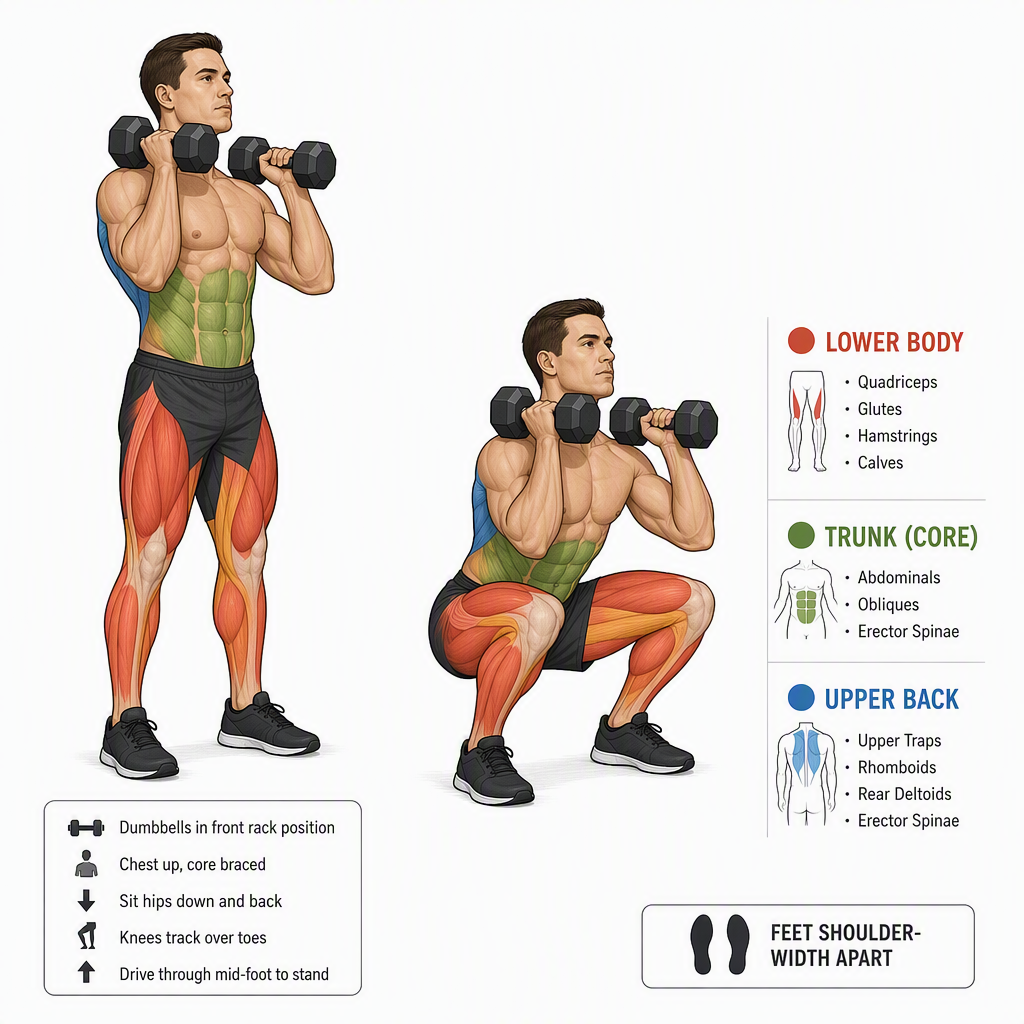
Because the load sits at the front of your body, your posture muscles must stay active the whole time, especially considering your stance width. Below is a closer look at the main muscles involved and how they contribute to each rep.
Quadriceps, Glutes, and Hamstrings Activation
Your quads do much of the work in the dumbbell squat front squat, especially as you stand up. The glutes support hip extension, while the hamstrings help control the movement and assist through the squat pattern. Together, they drive strong lower body output.
Here is a simple text table comparing emphasis:
|
Squat Type |
Main Emphasis |
|---|---|
|
Dumbbell front squat |
Strong quadriceps activation, plus glutes and hamstrings |
|
Goblet squat |
Similar pattern, but upper back fatigue may limit load |
|
Dumbbell sumo squat |
More glutes and adductor longus activation |
For maximum results from these muscles, strive for full-depth squats and consistent repetitions; reaching proper squat depth enhances muscle engagement and, over time, is likely to increase lower limb muscle mass more than performing partial reps.
Core, Back, and Supporting Muscle Engagement
The dumbbell front squat is not just a leg move. Your core engagement helps keep the torso from collapsing, while the erector spinae and other back muscles stabilize your spine during the entire set, especially when compared to barbell squatting.
Supporting muscles in the shoulders and traps also matter because they help hold the dumbbells in the front rack. Without them, the weight drifts and your squat form breaks down. That is why this exercise trains more than the lower body alone.
If you want better muscle activity here, focus on bracing before each rep and keeping the elbows lifted. A strong upper back and tight midsection move feel smoother and help you stay in position from top to bottom.
(ALSO READ: Top 6 Front Squat Alternatives for Building Leg Strength)
Conclusion
In conclusion, mastering the best variations of the dumbbell front squat not only enhances your lower body strength but also significantly improves your posture and functional movement. By focusing on proper form and technique, you can avoid common mistakes that may hinder your progress. Incorporating this exercise into your routine will engage key muscle groups, including the quadriceps, glutes, and core, providing a comprehensive workout. Remember, consistency is key! Contact our fitness professionals today for a complimentary consultation if you want tailored advice or to refine your technique, and begin your path to improved strength and stability right away!
Are front squats less effective than back squats?
Front squats and back squats both offer unique benefits. While back squats emphasize overall strength, dumbbell front squats target the quads and core more intensely. Each variation has its advantages, so neither is inherently less effective; it depends on your specific fitness goals and training focus.
REFERENCE:
https://www.nerdfitness.com/blog/strength-training-101-how-to-squat-properly/
https://www.nerdfitness.com/blog/a-beginners-guide-to-the-gym-everything-you-need-to-know/
https://pubmed.ncbi.nlm.nih.gov/19002072/
https://pubmed.ncbi.nlm.nih.gov/31230110/