

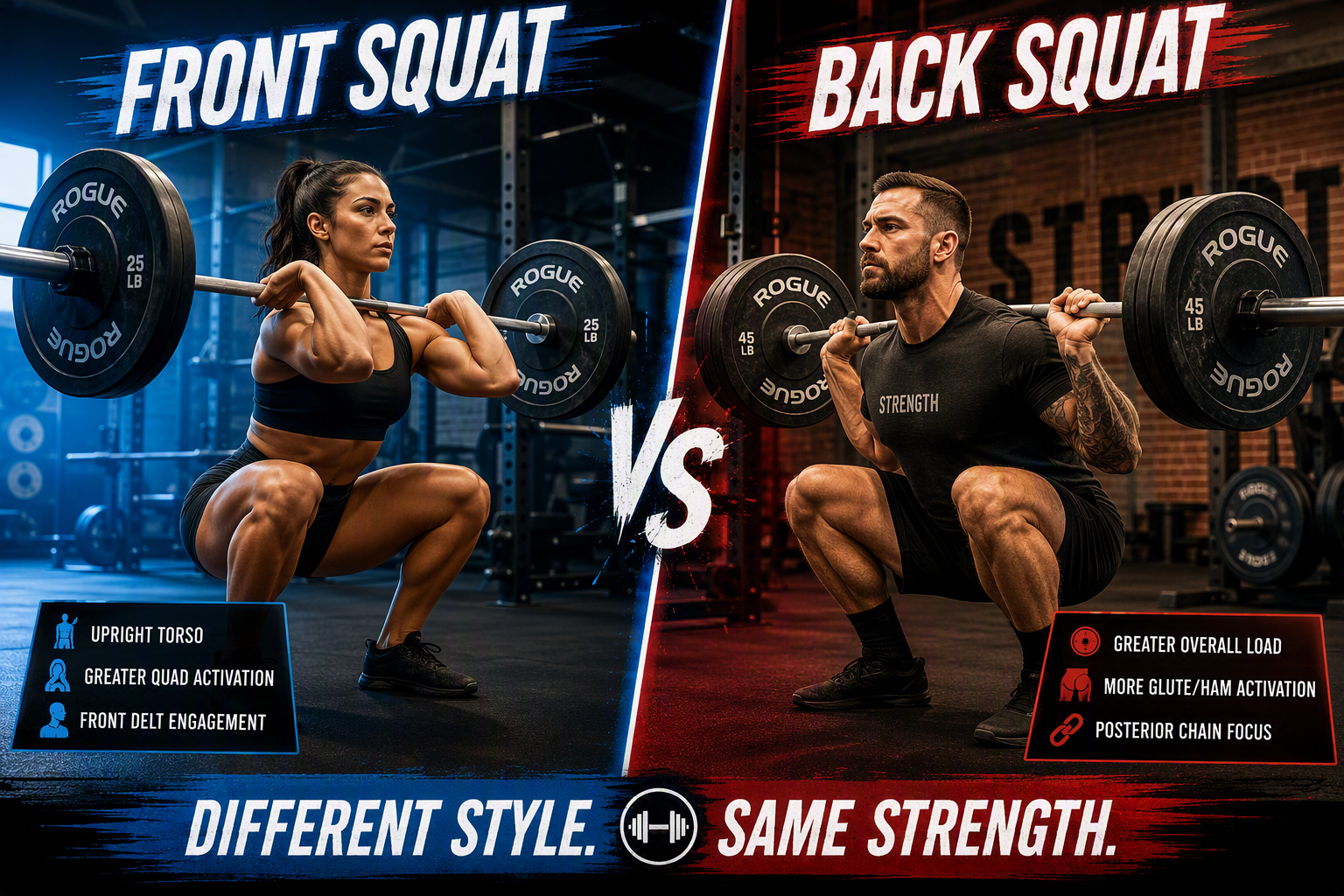
Key Highlights
- Typically, the front squat-to-back squat ratio for most athletes is about 80% to 90%;
- When intermediate lifters have strong technique, their ratios tend to align within that same range for the back squat.
- Your squat strength is shaped by training level, sport demands, and body weight.
- Front squat and back squat strength standards are not identical because each lift tests leg strength differently.
- Good technique comes first. Better front squatting often leads to more usable squat strength.
Introduction
If you know your back squat, it is natural to wonder what your front squat should be. That is where the front squat to back squat ratio helps. It gives you a simple way to benchmark squat strength without guessing. For most athletes, the ratio offers a useful range rather than one perfect number. It also helps you see whether technique, leg strength, or training background may be holding you back. Let’s break down what that ratio really means.
CLICK HERE
Understanding the Front Squat to Back Squat Ratio
The front squat ratio compares your front squat to your back squat. It is usually based on a 1RM, so you are comparing your best front squat and back squat under the same conditions.
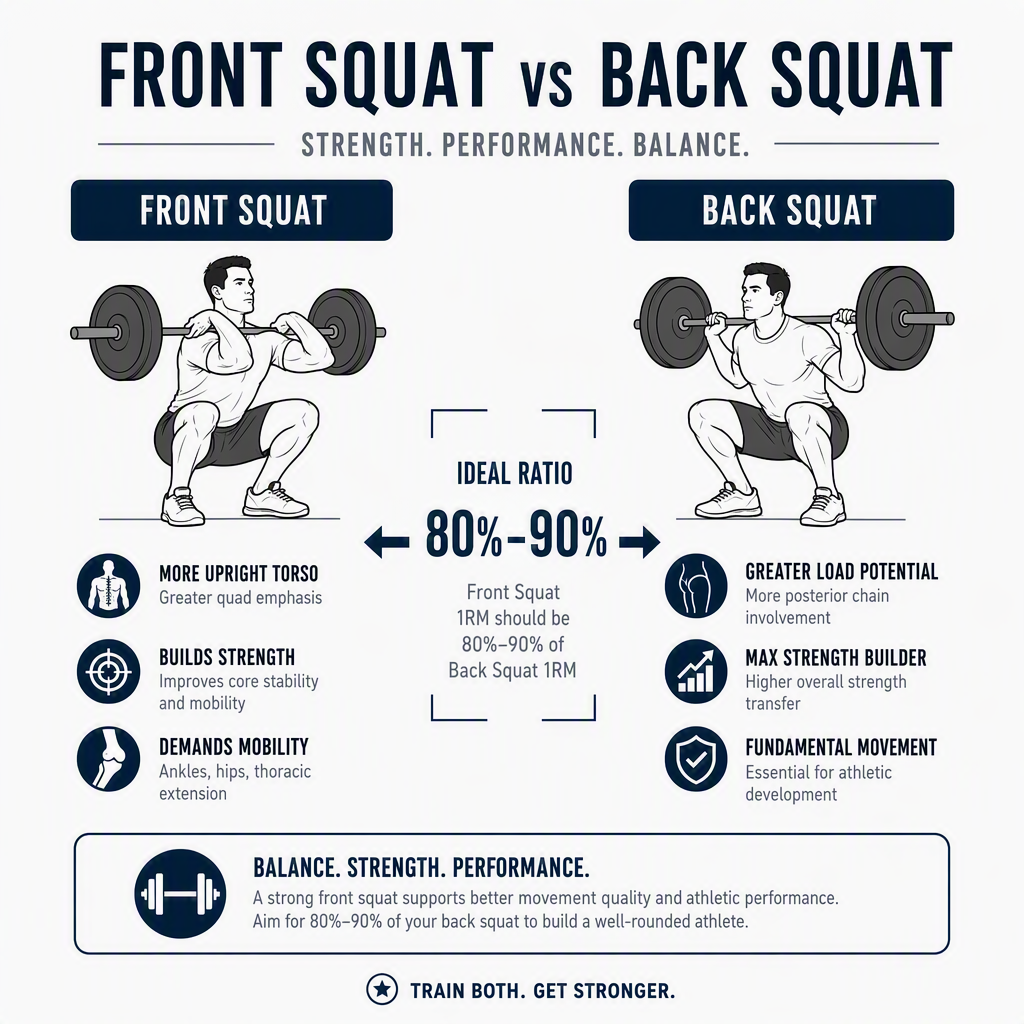
For most athletes, the front squat sits between 80% and 90% of the back squat. A typical front squat to back squat ratio for intermediate lifters is often in that range too, though some athletes fall as low as 75% or as high as 95%. Technique and training history explain a lot of that spread.
(ALSO READ: Front Squat Exercise: Key Form Tips for Success)
Definition and Significance for Athletes
In simple terms, the front squat ratio tells you how your front squat compares with your back squat. If your back squat is 150 kg and your front squat is 120 kg, your front squat ratio is 80%. That gives you a clear benchmark.
For intermediate lifters, 80% to 90% is a common range. Still, this is not a rule that fits everyone. Some athletes front squat less because their rack position, posture, or timing limits them before leg strength does.
Why does this matter for weightlifters? The catch and recovery phase of the clean is basically a front squat. If your front squat strength is too low, standing up with heavy cleans becomes harder. That is why this ratio is useful for athletes who need strong, efficient squat strength.
Common Standards Across Sports
Strength standards do differ between front squat and back squat. Most people can handle more back squat weight because of bar position and mechanics. Front squat standards are usually lower, even when both lifts are trained well.
Sport also matters. Athletes in strength and power sports usually need higher numbers than athletes in endurance-based sports. That is why general strength standards are only a starting point, not a final answer.
|
Sport type |
Likely strength standard trend |
|---|---|
|
Strength and power sports |
Higher front squat and back squat targets |
|
Mixed-field sports |
Moderate targets based on role and training |
|
Endurance-heavy sports |
Lower squat benchmarks due to other demands |
(ALSO READ: Master the Back Barbell Squat: A Beginner's Guide)
Why the Front Squat to Back Squat Ratio Matters
A number on its own does not say much. The front squat to back squat ratio matters because it shows how balanced your squat strength really is. You can use it to judge whether your front squat strength matches your back squat ability.
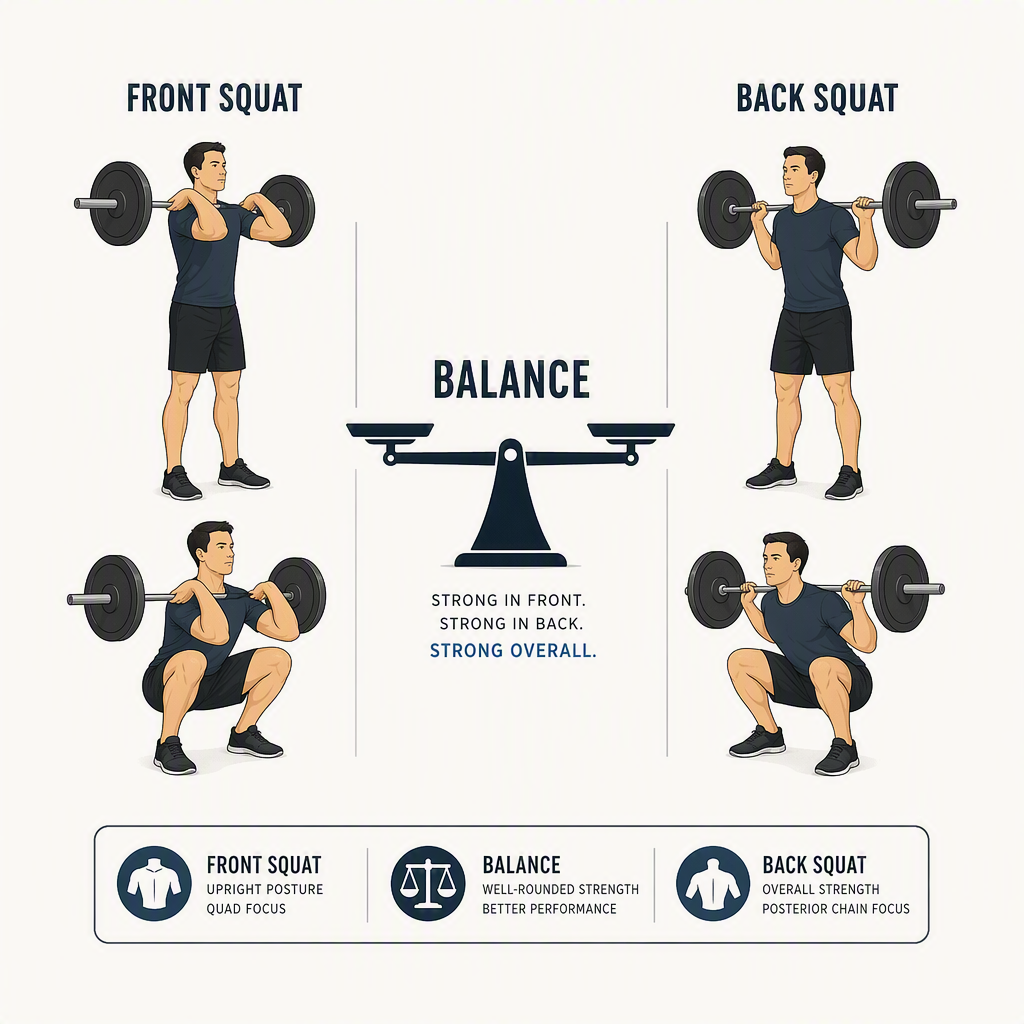
For weightlifters, this is especially helpful because the front rack squat position shows up in the clean. If your ratio is unusually low, your back squat may be outpacing the lift you need to recover from heavy catches. That leads well into sport-specific use.
Importance for Weightlifting Performance
In Olympic lifting, the front squat is not just an accessory. It supports the clean because you must receive the bar and stand up under control. That makes the front squat to back squat ratio a practical checkpoint.
A useful ratio helps show whether your leg strength transfers to the positions you use in training and competition. If your back squat climbs but your front squat does not, you may need more work on posture, rack position, or specific squat strength.
- It shows if your front-side squat strength is keeping up with your back squat.
- It helps identify weak links that affect clean recovery.
- It gives coaches and athletes a simple benchmark for progress.
Relevance in Powerlifting and Strength Training
In powerlifting, the back squat is the competition lift, so it usually gets more attention. That means an ideal front squat to back squat ratio for powerlifting is not fixed. The front squat is more of a support exercise.
Still, the front squat can help build positions, control, and quad strength. If your back squat is moving well, a lower front squat ratio may not be a problem. If your front squat is very weak, it may point to technical gaps or limited upright strength.
For general strength training, front squat standards can still be useful. They help you compare lifts, track progress, and decide whether your training is balanced enough for your goals.
(ALSO READ: Top 6 Front Squat Alternatives for Building Leg Strength)
Typical Ratios for Different Athlete Levels
Most athletes want a quick benchmark. A typical front squat ratio for intermediate lifters is usually 80% to 90% of the back squat. That same range works as a practical guide for many trained athletes.
Beginners may sit lower while learning positions, and advanced athletes can move toward the higher end if front squat max ability is well developed. These strength standards are not perfect, but they give your squat training direction.
Beginner, Intermediate, and Advanced Standards
Levels are best viewed as ranges, not labels. A newer lifter may still be building technique, while an experienced athlete often shows better front squat strength relative to back squat weight.
Bodyweight benchmarks also help. For female athletes, about 1 times bodyweight is achievable and over 1.4 times bodyweight is excellent. For male athletes, 1.2 times bodyweight is achievable and over 2 times bodyweight is excellent.
|
Level |
Front squat to back squat ratio |
|---|---|
|
Beginner |
Often below 80% while learning |
|
Intermediate |
Commonly 80% to 90% |
|
Advanced |
Often near the top of that range, sometimes higher |
Variations for Male and Female Athletes
Male and female athletes can both use the same ratio idea, but body weight standards are often discussed differently. The key point is not sex alone. Training age, sport, and goals matter a lot.
The compiled guidance gives practical body weight markers rather than separate ratio formulas in kg. Those can help you set realistic front squat and back squat targets without assuming everyone should lift the same number.
- Female athletes: around 1 time body weight is achievable; over 1.4 is excellent.
- Male athletes: around 1.2 times body weight is achievable; over 2 is excellent.
- Front squat and back squat standards still differ because the lifts are not the same task.
Calculating Your Front Squat to Back Squat Ratio
Calculating your front squat ratio is simple. Take your front squat max and divide it by your back squat max. To convert the ratio into a percentage, multiply it by 100; this percentage represents your back squat ratio in comparison.
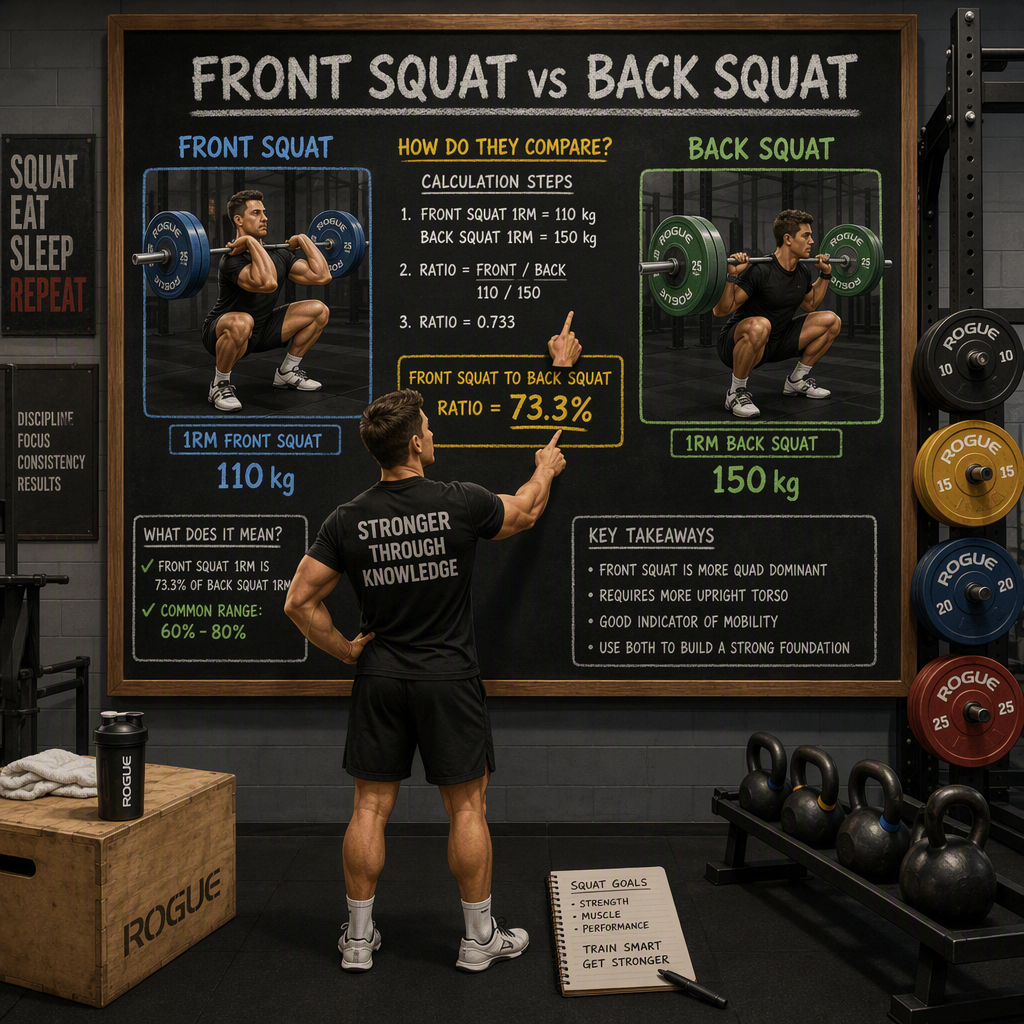
If you know one lift but not the other, you can estimate. For example, if your back squat is 100 kg, a projected front squat max of 80 to 90 kg fits the common range. Next, here is a quick method you can use.
Step-by-Step Calculation Method
Start with your best tested or estimated 1RM for each squat. If you do not test a true max, you can use other methods to estimate your lift from a heavy rep set. Just stay consistent.
Then divide front squat weight by back squat weight. If your front squat weight is 85 kg and your back squat weight is 100 kg, your front squat ratio is 0.85, or 85%.
- Formula: front squat ÷ back squat × 100
- Example: 85 kg ÷ 100 kg × 100 = 85%
- If you know your back squat max, front squat is often about 80% to 90% of it
Using Ratio Calculators for Tracking Progress
A calculator can be useful if it saves time and helps you track trends. It will not replace coaching, but it can organize your front squat max, back squat, and ratio in one place.
This is helpful because training changes over time. Your numbers may shift as technique improves, or as your program emphasizes one squat more than the other. A calculator makes those patterns easier to see.
- Use a calculator if you want quick percentage checks
- Track changes over several training blocks, not one session
- Treat the result as a guide, not a judgment
Factors Influencing Squat Ratio Differences
Your front squat ratio is shaped by more than raw strength. Age, training level, training age, sport background, goals, and other training responsibilities all play a role. Even body weight targets should be viewed in that bigger context.
Certain athletes experience rapid improvement since their sport naturally builds power, while others develop more slowly due to endurance training or restricted mobility, which can hinder their performance in both front and back squats; these distinctions are explored in the following two sections.
Impact of Training Frequency and Technique
Yes, training affects the front squat to back squat ratio over time. If you practice front squat more often and improve technique, the ratio can rise. Better execution lets you apply squat strength more effectively.
That is why technical work matters so much. Without proper form, athletes often hit a wall that has less to do with leg strength and more to do with poor positions. Fixing the lift can raise your usable strength standards.
Specific exercises can help if they improve the lift itself. In the compiled material, the main message is clear: sort out technique first, then load it. Once the movement is solid, progress in training usually follows.
Role of Anatomy and Mobility
Anatomy and mobility influence how comfortable and strong you feel in each squat. The front squat demands a more upright position and a solid rack, so mobility limits can lower front squat strength even when back squat numbers look good.
This helps explain why ratios vary from 75% to 95%. Two athletes with the same back squat may not front squat the same amount if one struggles with positions or movement quality.
It also explains why there is no single perfect benchmark. Your squat ratio reflects your structure, skill, and preparation. That is why the best comparison is your own progress over time, not someone else’s numbers.
Conclusion
Understanding the front squat to back squat ratio can greatly enhance an athlete's performance and training regimen. By recognizing the significance of this ratio and how it varies across different levels and sports, athletes can tailor their workouts for optimal results. It's essential to calculate your own ratios and consider factors such as training frequency, technique, and individual anatomy. Remember, achieving balance between these squats not only boosts strength but also promotes injury prevention. If you’re eager to refine your training, don’t hesitate to reach out for personalized guidance or support—your progress starts with informed choices!
Front squat is 60 percent of the back squat- what's the cure?
To improve your front squat to back squat ratio, focus on enhancing core strength, flexibility, and technique. Incorporate specific mobility exercises and practice front squats regularly. Additionally, consider adjusting your training program to include accessory lifts that target muscles used in the front squat for balanced development.
REFERENCE:
https://blog.twl.com.au/how-to-do-the-kettlebell-sumo-squats/
https://blog.twl.com.au/push-press-how-to-benefits-muscles-worked/
https://barbend.com/how-much-should-you-clean-in-relationship-to-your-front-squat/
https://christianbosse.com/category/articles/strength-training/
https://christianbosse.com/category/videos/front-squat-videos/
https://btwb.blog/2017/10/03/all-the-squats/