

Key Highlights
- A front squat shifts load to the front, changing how your lower body and core work.
- Each squat variation changes muscle groups trained through load position, control demands, and depth.
- Proper form matters because an upright torso helps you stay balanced and protect your back.
- Beginner options use lighter resistance to teach movement before heavier loading.
- Advanced choices focus on building muscle, strength from the bottom, and upper back control.
- Your best option depends on equipment, skill level, and training goals.
Introduction
The front squat is one of the most useful ways to train your lower body while challenging several muscle groups at once, including the teardrop muscle. Because the load sits in front, your squat position changes compared with other squat patterns, and that creates a different training effect. You get strong legs, a harder-working core, and more demand on posture. If you want a smart way to improve technique, strength, and control, learning front squat variations is a great next step.
Understanding Front Squat Variations
A front squat places resistance at the front of your body, often across the front of your shoulders in a rack position or front rack position. That setup changes balance, posture, and how hard your greater core strength and upper back must work during each rep.
Different choices change muscle activation by altering load, stability, and range of motion. A band, landmine, dumbbells, kettlebells, or a barbell each create a distinct squat variation. Some are better for learning, while others are better for building muscle or improving strength out of the bottom.
(ALSO READ: Front Squat Exercise: Key Form Tips for Success)
What Makes Front Squats Unique?
What makes the front squat stand out is where the weight sits. Instead of resting across your back, the load stays at the front of your body, which is essential for Olympic weightlifting movements. That immediately changes your squat position and forces you to stay more upright through the lift.
Because of that upright torso, the exercise demands more from your upper back and core, especially when using the best barbells. You cannot lean forward much without losing the load. This creates a different pattern of muscle activation than a back-loaded squat and often feels more controlled for the lower back.
The classic version uses a barbell in the front rack, but other front squat variations change the tool, load, or pause style. Even with those changes, the main idea stays the same: keep the chest tall, control the descent, and drive up without letting position break down.
Classic Front Squat vs. Other Variations
The barbell front squat is the standard version. In the starting position, the bar rests in the front rack position, supported by the shoulders and upper body. This setup lets you train the lower body hard while keeping your torso upright, tall, and braced.
Compared with a back squat, you will usually use less weight. Still, that does not make it less effective. The front-loaded position shifts stress toward the quads, anterior core, low back, and upper back, while your glutes and hamstrings still help throughout the rep.
Each squat variation changes the challenge. Landmine and goblet styles make it easier to stay upright. Pause and Anderson versions build strength from the bottom. Single-arm options increase core demand and expose side-to-side weakness, so different versions target muscle groups through position and control.
Essential Equipment for Front Squat Variations
You do not need the same equipment for every front squat variation. A barbell front squat usually calls for a squat rack, while a kettlebell front squat, dumbbell version, or resistance band option can be done with simpler gear, allowing for exercises like the hack squat to be included. That makes front squatting easier to fit into different training spaces.
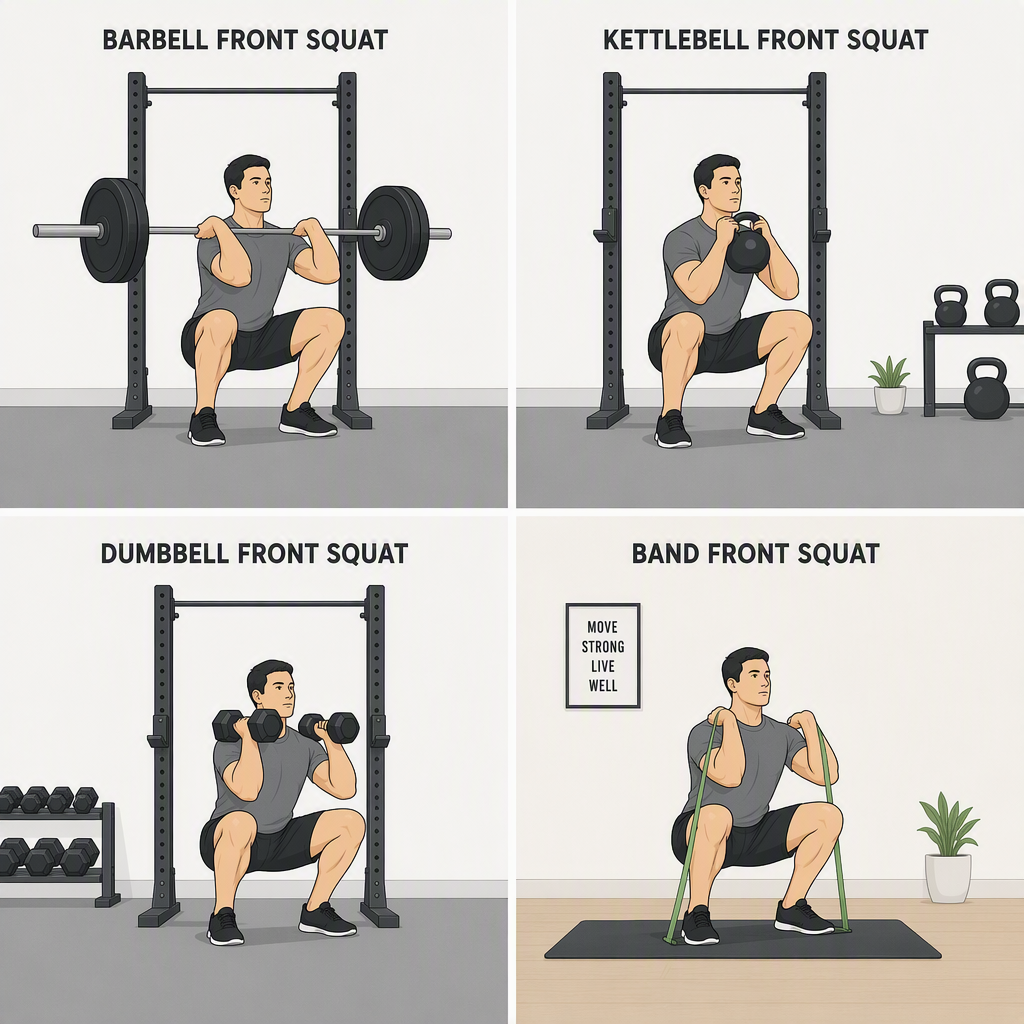
The best tool depends on your goal and experience. Bands and landmine setups help beginners learn posture. Dumbbells and kettlebells build control. Barbells are the main choice when you want heavier loading. Next, let’s look at how each tool changes the movement.
Barbell, Dumbbell, and Kettlebell Options
If you want simple front squat options, start with the most common tools. The barbell front squat, often considered the king of all leg exercises, is the heaviest choice and works well for strength. A dumbbell front squat teaches position with more freedom, while kettlebell front squats add a strong demand on balance and bracing.
Each tool shifts muscle activation in a slightly different way. Barbells let you use more total load. Dumbbells often mean less load but more control. Kettlebells challenge your rack position, grip, and upper back in a way many lifters notice right away.
- Barbell front squat: best for heavy strength work and a strong front rack, targeting the vastus medialis for improved quad strength.
- Dumbbell front squat: useful for learning posture and control with less load.
- Double dumbbell work: close to barbell mechanics without the bar.
- Kettlebell front squats: great for anterior core and grip demand.
- Double kettlebell loading: strong beginner-to-intermediate bridge.
Alternative Tools: Resistance Bands, Landmine, and Smith Machine
Alternative tools can make the movement easier to learn or easier to control. A resistance band gives light, accommodating tension and is friendly on the joints. The landmine front squat guides the path of the bar and helps you stay tall through the rep.
These setups also affect range of motion and comfort. The landmine arc can make the bottom easier to reach. That helps beginners learn the pattern before trying more advanced front squat variations. A Smith machine can guide the movement too, though the compiled training focus leans more heavily toward bands, landmine, kettlebells, dumbbells, and barbells.
- Resistance band: useful for beginners and higher-rep practice.
- Landmine front squat: great for posture, depth, and learning the pattern.
- Single-arm landmine: adds lateral stability and core demand.
- Smith machine: guided path, though less emphasized than free-weight options.
(ALSO READ: Top 6 Front Squat Alternatives for Building Leg Strength)
Beginner’s Guide to Front Squat Variations
If you are new to the front squat, start with a squat variation that teaches posture before heavy loading. The best front squat variations for beginners include resistance band, landmine, double dumbbell, and double kettlebell options, allowing you to build up to your most serious, baddest max attempts. These choices build control without forcing you into a difficult setup too soon.
You can also rehearse the pattern with bodyweight and then add lighter weight once proper form feels steady. The goal is not to rush. It is to learn balance, depth, and rack comfort so later progress feels smooth and safe.
Key Tips for Safe Technique
Safe technique starts with position, not load. Before you add plates, make sure your starting position is balanced and repeatable. A stable stance, braced trunk, and tall chest help you keep proper form from top to bottom.
Good setup also lowers the risk of injury. If you use a squat rack, set the bar at a height that lets you unrack without wasting energy. Then focus on smooth reps and control instead of chasing numbers too early.
- Brace your core strength before every rep.
- Keep an upright torso as you descend and rise.
- Use a squat rack height that matches your build.
- Start with a load you can control fully.
- Progress only when your starting position stays consistent.
As technique improves, move from beginner tools to barbell versions, then to pauses or pin-based work.
Starting With Bodyweight and Light Resistance
A smart beginning often starts without much load. Bodyweight practice helps you learn the squat position, stay balanced, and feel how your knees, hips, and torso move together. Once that pattern feels natural, add lighter weight to keep building confidence.
From there, resistance band and landmine versions are useful next steps. They help you keep a tall posture and often make safe technique easier to hold for full reps. This is also a simple way to improve range of motion without the stress of a heavy barbell.
- Use bodyweight to learn depth and balance first.
- Add a resistance band for controlled, higher-rep practice.
- Try a landmine front squat for a guided path.
- Move to double dumbbell or kettlebell loading when ready.
These options answer the beginner question clearly: start simple, then add challenge in small steps.
(ALSO READ: Discover the Benefits of Front Squats for Strength Gains)
Step-by-Step Guide to Performing Front Squat Variations
A good front squat starts with a repeatable setup and a clear movement pattern. No matter which variation you choose, you want the same basics: balanced feet, a secure rack position, and controlled descent, which will help build anterior core strength. That creates better muscle activation and more consistent reps.
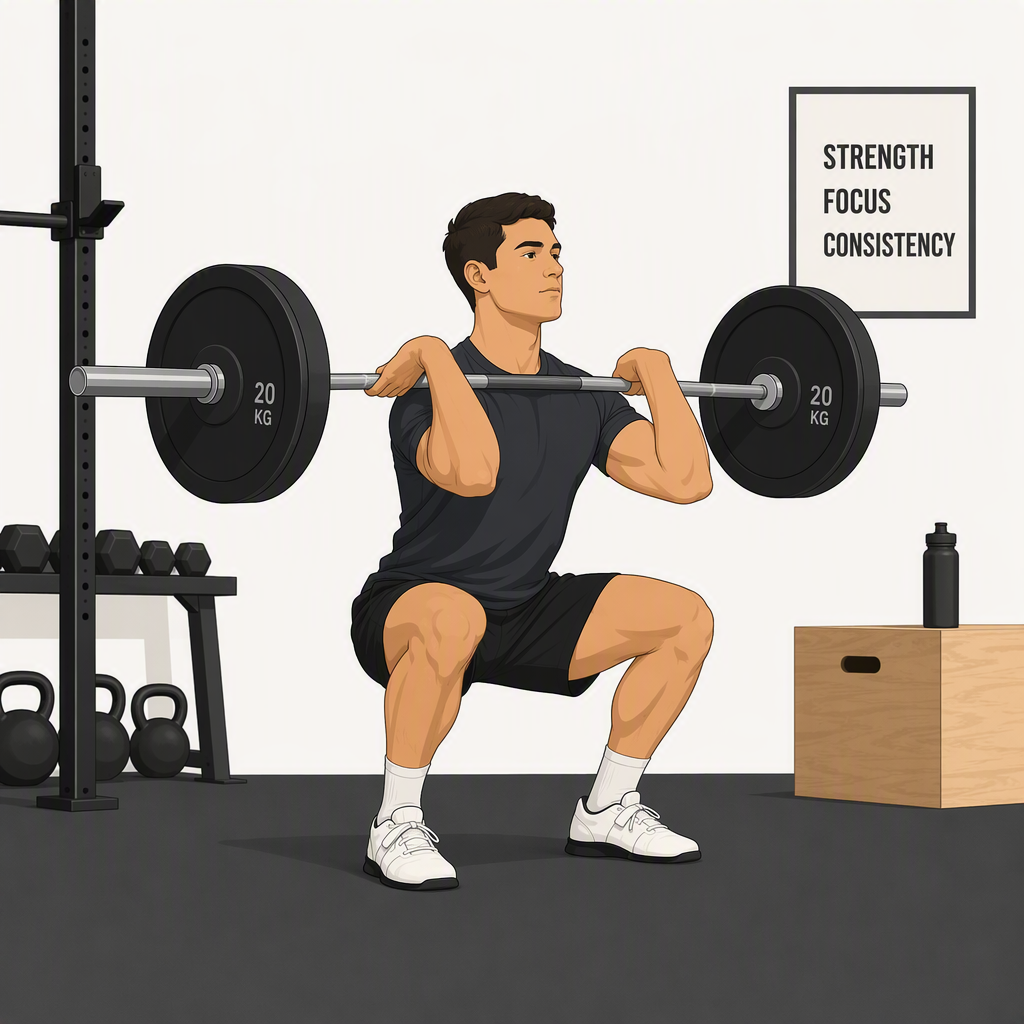
Progression happens when each piece improves. First learn the squat position, then master the hold, then add load or pauses. The steps below make that process easier and help you build toward more demanding variations without rushing.
Step 1: Setting Up Properly
Your setup shapes the whole rep. For a barbell front squat, begin in the squat rack with the bar placed so you can step under it without rising onto your toes. The bar should settle on the front of your shoulders, not in your hands alone.
Next, find a starting position you can repeat every time. Stand with your feet in a comfortable squat position and lift your chest before you unrack. Once the bar is secure, step back carefully and reset your breath before you descend.
- Set the squat rack at a manageable height.
- Position the bar so it rests along the front of your shoulders.
- Establish a balanced starting position before unracking.
- Step back only enough to clear the rack.
- Re-brace before beginning the first rep.
A clean setup makes every later progression easier, whether you use dumbbells, kettlebells, or a landmine.
Step 2: Mastering the Front Rack Position
The front rack position is often the hardest part for beginners. The load must stay high and stable while your elbows remain lifted. This demands upper back strength, a secure rack position, and enough comfort to avoid losing posture before the squat even starts.
When wrist mobility is restricted, start training with dumbbells, kettlebells, or landmine exercises, since these alternatives ease the rigid requirements of using a barbell rack while still allowing you to develop an identical movement pattern. Gradually, repetition will enhance your ease, grip strength, and bar-holding proficiency.
- Keep the elbows lifted to support the load.
- Let the shoulders, not just the hands, carry the weight.
- Use dumbbells or kettlebells if wrist mobility is limited.
- Build upper back strength before forcing a barbell position.
This is one of the easiest ways to modify the front squat without changing its main training effect.
Step 3: Executing the Squat Movement
Once the load is secure, focus on a clean descent and rise. Sit into your squat position while keeping your chest tall. The goal is an upright torso that stays stable as you move through the rep, not a rushed drop into the hole.
At the bottom, use the deepest range of motion you can control. Then drive upward without letting the elbows fall or the torso tip forward. This movement pattern helps train your quads strongly while your hip flexors, glutes, hamstrings, core, and upper back support the lift.
- Descend under control with an upright torso.
- Reach a range of motion you can own.
- Drive up smoothly from the bottom position.
- Keep the same movement pattern on every rep.
Different front squat variations target muscle groups by changing stability, pauses, or how much load you can manage.
Step 4: Common Mistakes and How to Avoid Them
Most common mistakes happen when lifters add too much too soon. If the elbows drop, the chest caves, or the bar shifts forward, proper form usually breaks down fast. That can increase the risk of injury and make the exercise feel worse than it should.
Another issue is forcing heavy reps before the pattern is ready. The front squat requires less weight than back squats, and that is normal. Using less weight while staying upright is usually more productive than grinding through messy reps that stress the lower back.
- Do not let the elbows collapse downward.
- Avoid leaning forward out of the hole.
- Reduce the load if depth or balance is poor.
- Use less weight until proper form is consistent.
- Fix setup problems before adding intensity.
For pure strength, barbell, pause, and Anderson variations are often the most effective once technique is solid.
Popular Front Squat Variations and Their Benefits
There are many useful front squat variations, and each one changes the training stress a bit. Some improve technique, some build more control, and others develop strength in difficult positions, emphasizing a vertical torso position. Across all of them, you train the lower body while asking a lot from the upper back and core.
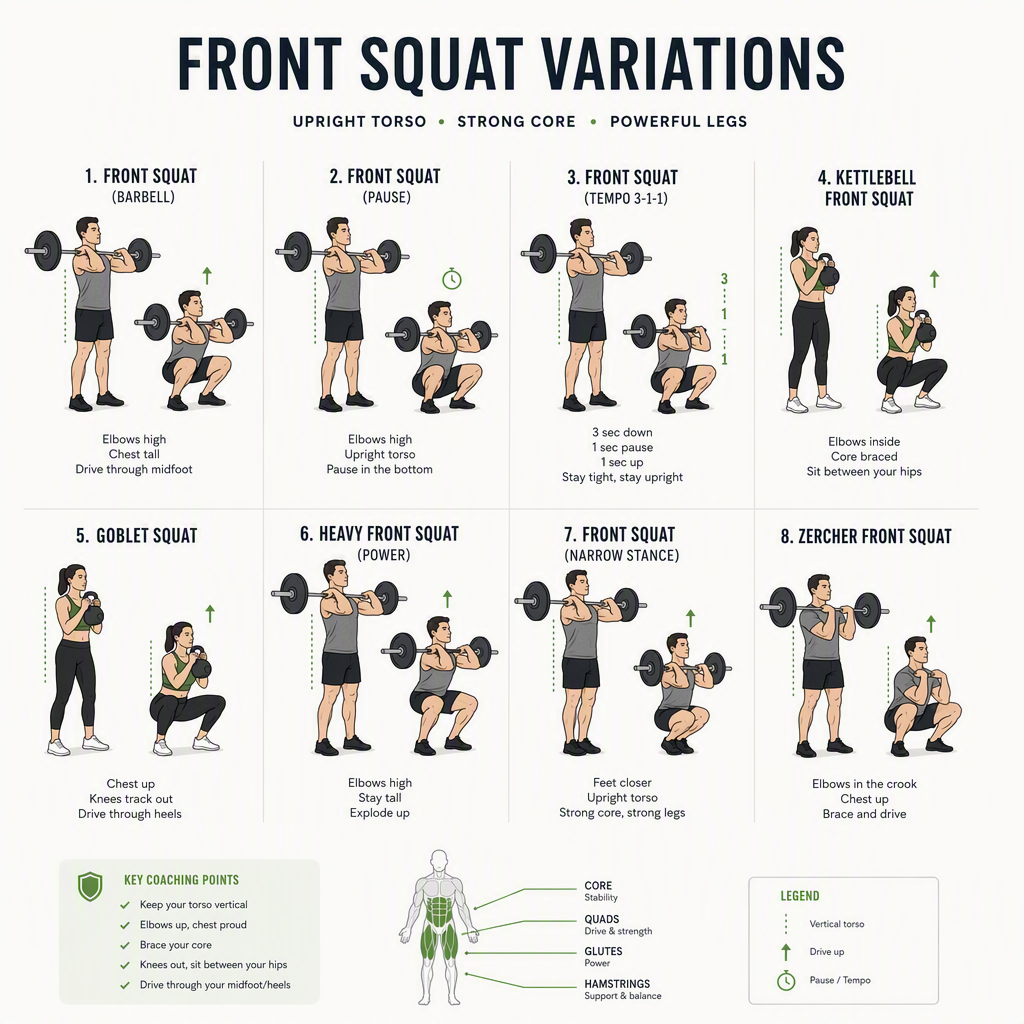
Your best match depends on experience and goal. Beginner-friendly tools help with posture and depth, while advanced front squat variations raise intensity with pauses, dead stops, or unstable loading. Here are some of the most practical choices and what they offer.
Goblet Front Squat and Double Kettlebell Front Squat
The goblet squat is one of the easiest ways to learn a front-loaded squat position. Holding one weight in front helps you stay tall and sit into the movement with control. It works well for beginners, warm-ups, and higher reps when you want to practice technique.
The double kettlebell front squat is more demanding. With two bells racked, you get a stronger challenge to your core, upper back, and grip, acting like shock absorbers for your knees. It also helps you get used to pressure across the front of the body before moving to a barbell.
|
Variation |
Main Benefit |
Best Use |
|---|---|---|
|
Goblet squat |
Teaches posture and controlled depth |
Beginners and mobility-focused practice |
|
Double kettlebell front squat |
Builds rack tolerance, grip, and core control |
Progressing toward barbell work |
|
Goblet squat with higher reps |
Reinforces pattern under light fatigue |
Technique and conditioning |
|
Double kettlebell front squat |
Trains multiple muscle groups with front-loaded demand |
Strength and stability |
The goblet style frequently serves as the more accessible introduction for enhancing mobility.
Landmine Front Squat and Zercher Front Squat
When you're aiming to master the squat movement without struggling with a standard barbell rack, the landmine front squat is an excellent choice. The guided bar path encourages an upright posture, allows you to reach proper depth more easily, and boosts your confidence while practicing the motion. For beginners, it serves as one of the best ways to start learning how to squat.
The Zercher front squat is a more demanding choice and fits better with advanced moves. Even though it uses a different hold, it still places the load in front and asks a lot from your anterior core, spinal erectors, and posture. That can make it useful for lifters who want more front-loaded strength work.
For powerlifting performance, front-loaded variations such as landmine and a strong front squat barbell front squats can help by strengthening quads, core, and upper back. Those qualities support bigger squat training, even if the back squat remains the main competition-focused lift.
Pause Front Squat and Anderson Front Squat
A pause front squat removes momentum by making you hold the bottom position before standing up. That extra time under tension builds control, reinforces a strong squat position, and improves athletic performance by making light-to-moderate loads feel much harder. It is excellent for building strength out of the hole.
The Anderson front squat starts from a dead stop, usually from pins. Because there is no lowering phase to build momentum, you must create force instantly from the bottom position. That makes it one of the strongest choices for lifters who struggle at their sticking point.
Both variations are very effective for building strength. Pause work improves stability and positional control, while the Anderson front squat builds starting power. They also challenge grip strength and upper back endurance because the load must stay secure without any relaxation.
Conclusion
In summary, mastering front squat variations can significantly enhance your training regimen by building strength and improving your overall fitness. By understanding the unique aspects of these movements and employing proper techniques, you can maximize your results while minimizing the risk of injury. Whether you choose to incorporate classic variations like the goblet squat or opt for more advanced variations such as the landmine squat, each serves a purpose in developing your lower body strength. Remember, the key is to maintain good form and gradually increase resistance as you become more comfortable. If you're ready to take your training to the next level, don’t hesitate to give these variations a try!
Frequently Asked Questions
Which front squat variations are best for strength and muscle building?
For pure strength, the barbell front squat, barbell pause front squat, pause front squat, and Anderson front squat are strong choices. If your goal is to build strength and size across more muscle groups, double kettlebell and double dumbbell options also work well. Each squat variation changes muscle activation through load, control, and position.
REFERENCE:
https://pubmed.ncbi.nlm.nih.gov/25630691/
https://pubmed.ncbi.nlm.nih.gov/28704312/
https://www.ncbi.nlm.nih.gov/pmc/articles/PMC7039033/
https://www.ncbi.nlm.nih.gov/pmc/articles/PMC7831128/
https://www.ncbi.nlm.nih.gov/pmc/articles/PMC6279907/