


Key Highlights
- A smith machine squat uses a fixed bar path for a controlled movement, while a barbell squat is a free-weight exercise requiring balance.
- Barbell squats enhance functional strength by engaging more stabilizer muscles, leading to greater overall muscle activation.
- Smith machine squats allow for foot placement adjustments to isolate specific muscles like the glutes or quads.
- The barbell squat generally carries a higher injury risk due to the need for perfect squat form, while the Smith machine offers more stability.
- Your choice between them depends on your goals; barbell squats are better for overall strength, and Smith machine squats are great for muscle isolation and beginners.
- For home gyms, a squat rack offers more versatility, but a Smith machine is a safer option for solo lifters.
Introduction
When it comes to building a powerful lower body, the squat is king. But the debate between the smith machine squat vs barbell squat continues to divide the fitness community. Are you wondering which one is right for your leg workouts? Understanding the unique benefits and drawbacks of each exercise is crucial for maximizing your strength training results and achieving your fitness goals. Let's explore which squat variation will give you the best bang for your buck.
Understanding smith machine squat vs barbell squat
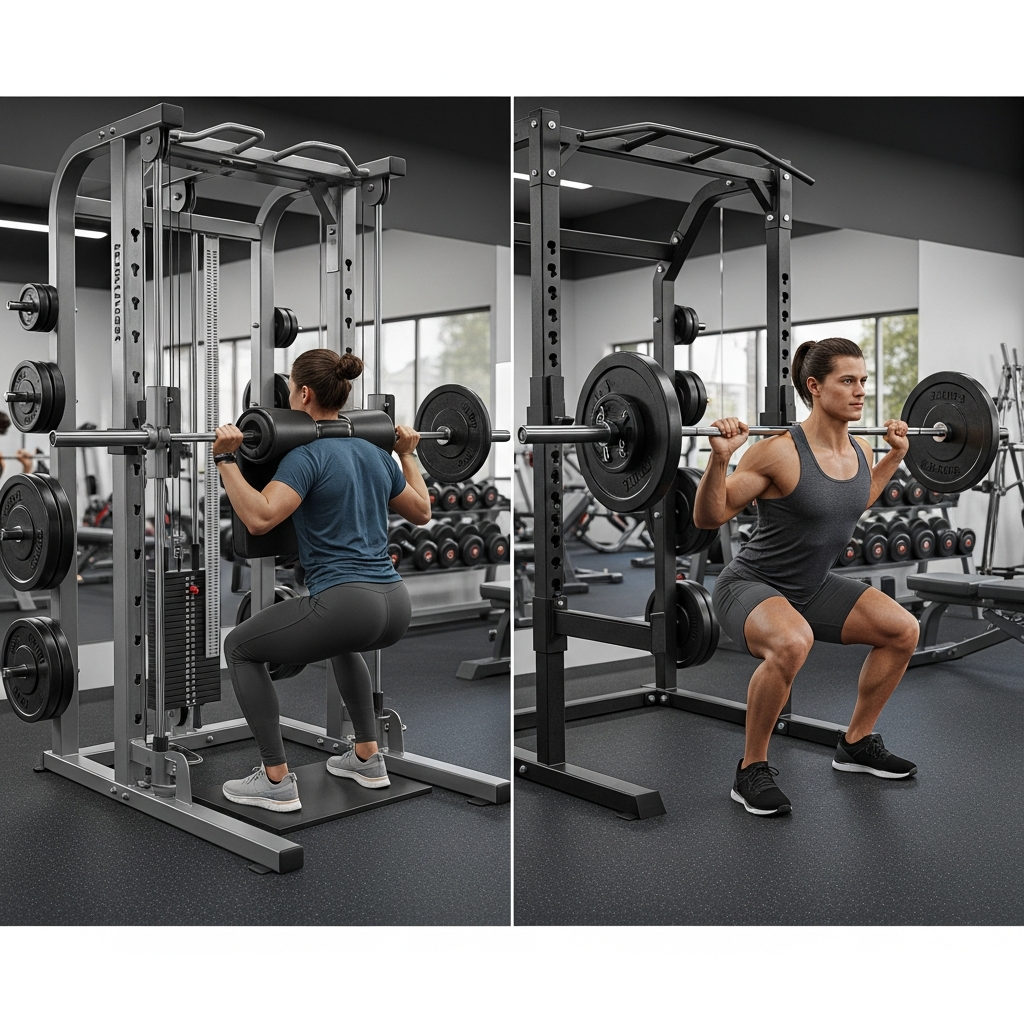
The smith machine squat and the barbell squat are both powerful exercises for your legs, but they operate on different principles. One offers a guided, controlled movement, while the other demands total body stabilization.
Choosing the right one for your fitness journey depends on your goals, experience, and even your anatomy. By understanding how each works, as a former collegiate football player, you can make an informed decision to build strength safely and effectively.
What Is a Smith Machine Squat?
A smith machine squat is performed on a piece of equipment where the barbell is fixed within steel rails. This setup locks the barbell into a strict vertical or slightly angled guided path. You don't have to worry about balancing the weight forward or backward, which is a key difference from free-weight squats.
This fixed bar path significantly changes the squat mechanics. Since the machine handles the stability, you can focus purely on pushing the weight. This controlled environment makes it a popular choice for isolating specific muscles and for lifters who may be new to squatting.
The main distinction from a barbell squat lies in this guided motion. The machine dictates the path, removing the need for your stabilizer muscles to work as hard. This allows you to alter your foot placement to target different muscle groups more directly.
What Is a Barbell Squat?
A barbell squat is a classic free-weight exercise performed using an Olympic barbell and weight plates, along with a squat rack or power rack for safety. Unlike the Smith machine, you are in complete control of the barbell's path, requiring you to balance the weight throughout the entire movement.
Because it activates several muscle groups throughout your body, this exercise is classified as a compound movement. Your core, back, and smaller stabilizer muscles must fire to keep you steady and maintain proper form. This leads to greater overall muscle activation compared to machine-based exercises.
The reliance on free weights means that barbell squats are excellent for building functional strength that translates to real-world activities. However, it also means there's a steeper learning curve to master the correct form and avoid injury, making it crucial to have a role model for proper technique.
(ALSO READ: Master the Back Barbell Squat: A Beginner's Guide)
How Each Squat Is Performed
The setup and execution for each squat are quite different, primarily due to the free vs. fixed nature of the barbell. Proper squat form is essential for both, but the cues vary.
For a barbell squat, your foot placement is typically shoulder-width apart, directly under the bar to maintain balance. It's essential that you guide the bar's movement on your own. In contrast, the Smith machine's fixed path allows for more variation in foot placement. You can place your feet further forward to shift the emphasis from your quads to your glutes and hamstrings.
Here’s a quick look at the squatting motion for each:
- Barbell Squat: Unrack the weight, step back, and brace your core. For back squats, descend by hinging at the hips and bending the knees, keeping the bar over your mid-foot. Push through your heels as you come back up.
- Smith Machine Squat: Position yourself under the bar and unhook it. You can place your feet forward. Descend by sitting back into a chair-like position. Drive up, with the machine guiding your path.
Key Differences Between Smith Machine Squats and Barbell Squats
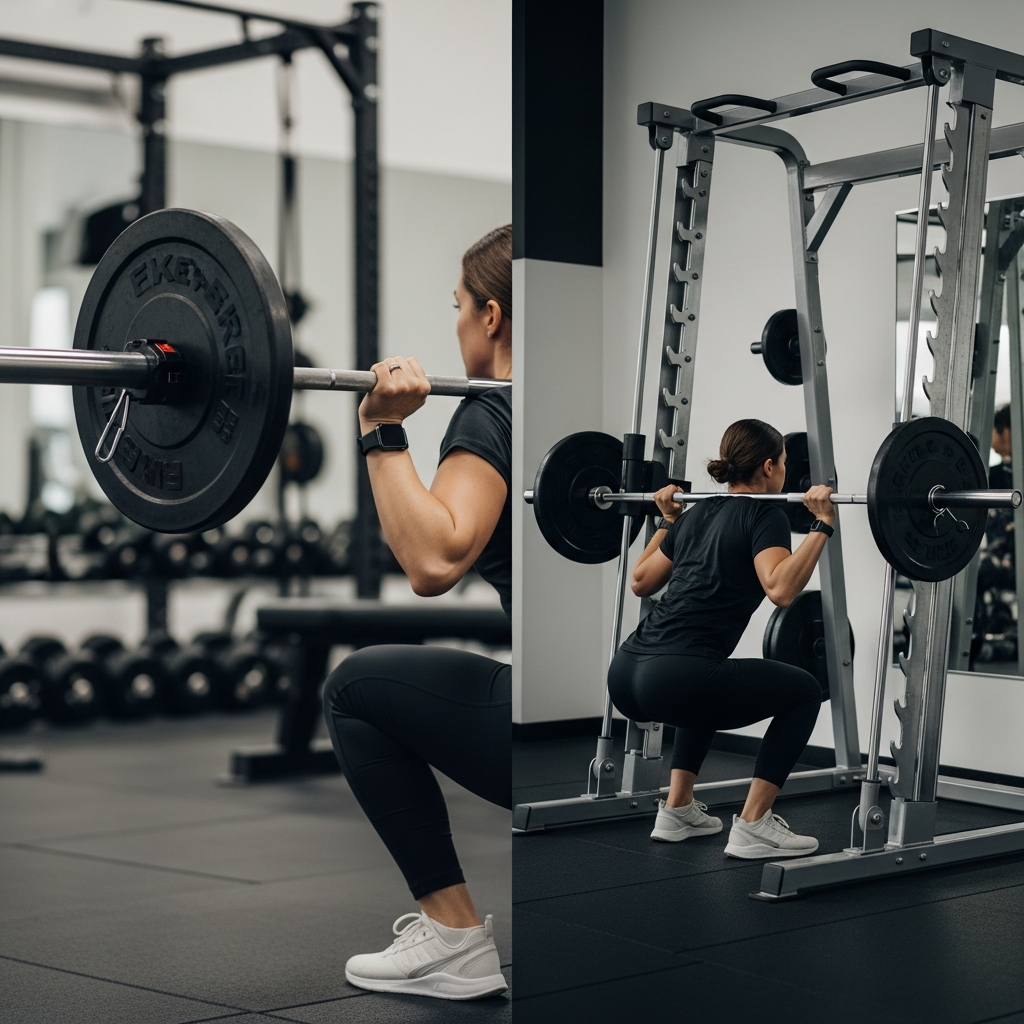
The primary distinction between the smith machine and barbell squat lies in stabilization and movement path, where stability plays a crucial role. The Smith machine provides a controlled path, guiding the bar for you, which eliminates the need to balance the weight. This changes the entire dynamic of the lift.
In contrast, the barbell squat forces your body to stabilize the load, engaging more muscles to maintain balance and proper form. These crucial distinctions affect aspects such as safety, muscle engagement, range of motion, and their appropriateness with your fitness objectives.
Mechanics and Range of Motion
The mechanics of these two squats are fundamentally different due to the bar path. A barbell squat requires you to create and control a natural bar path, which should be a straight vertical line over your mid-foot. This demands coordination and strength to prevent the bar from drifting forward or backward.
With a Smith machine, the bar path is fixed. It moves only up and down along the steel rails. This controlled path simplifies the movement but can feel unnatural for some lifters, as it forces your body into a rigid plane of motion. This might not align with your body's natural squat mechanics, potentially limiting your range of motion.
Let's compare them directly:
|
Feature |
Smith Machine Squat |
Barbell Squat |
|---|---|---|
|
Bar Path |
Fixed and guided by the machine's rails. |
Free-moving, controlled by the lifter. |
|
Range of Motion |
Can be limited by the machine's fixed path. |
Allows for a natural, full range of motion. |
|
Squat Mechanics |
Simplified, less need for balance. |
Complex, requires full-body stabilization. |
Stability and Balance Requirements
When it comes to stability and balance, the barbell squat is far more demanding. Since you're balancing a free weight on your back, your body must recruit a host of stabilizer muscles throughout your core, hips, and back to keep the bar secure and your body upright. This constant engagement is what makes the barbell squat such a powerful full-body exercise.
The Smith machine, on the other hand, removes the need for balance almost entirely. The fixed barbell path provides all the stability, allowing you to focus solely on pushing the weight. While this can help you isolate the primary movers like the quads and glutes, it means your smaller stabilizer muscles get a free pass.
Because of this, the barbell squat activates more muscle groups overall. The engagement of these additional muscles not only contributes to greater muscle activation but also helps build functional strength that translates to better balance and coordination in everyday life.
Common Uses in Gyms and Home Gyms
In most commercial gyms, you'll find both a smith machine and a squat rack, catering to different needs and experience levels. Beginners often start with the Smith machine to learn the basic squatting motion without the fear of losing balance. Bodybuilders also use it to isolate specific muscles or push to failure safely.
Barbell squats, performed in a squat rack or power rack, are a staple for those focused on building overall strength and functional fitness through metcon workouts. Powerlifters, athletes, and anyone serious about strength training will prioritize the barbell squat in their workout routine.
For a home gym, the choice between a Smith machine and a squat rack depends on your goals and budget. A squat rack is more versatile, allowing for various exercises beyond squats. However, a Smith machine provides an added layer of safety for those who train alone, as you can re-rack the weight at any point.
(ALSO READ: 7 Effective Barbell Back Squat Alternatives to Try Toda)
Muscle Activation and Strength Development
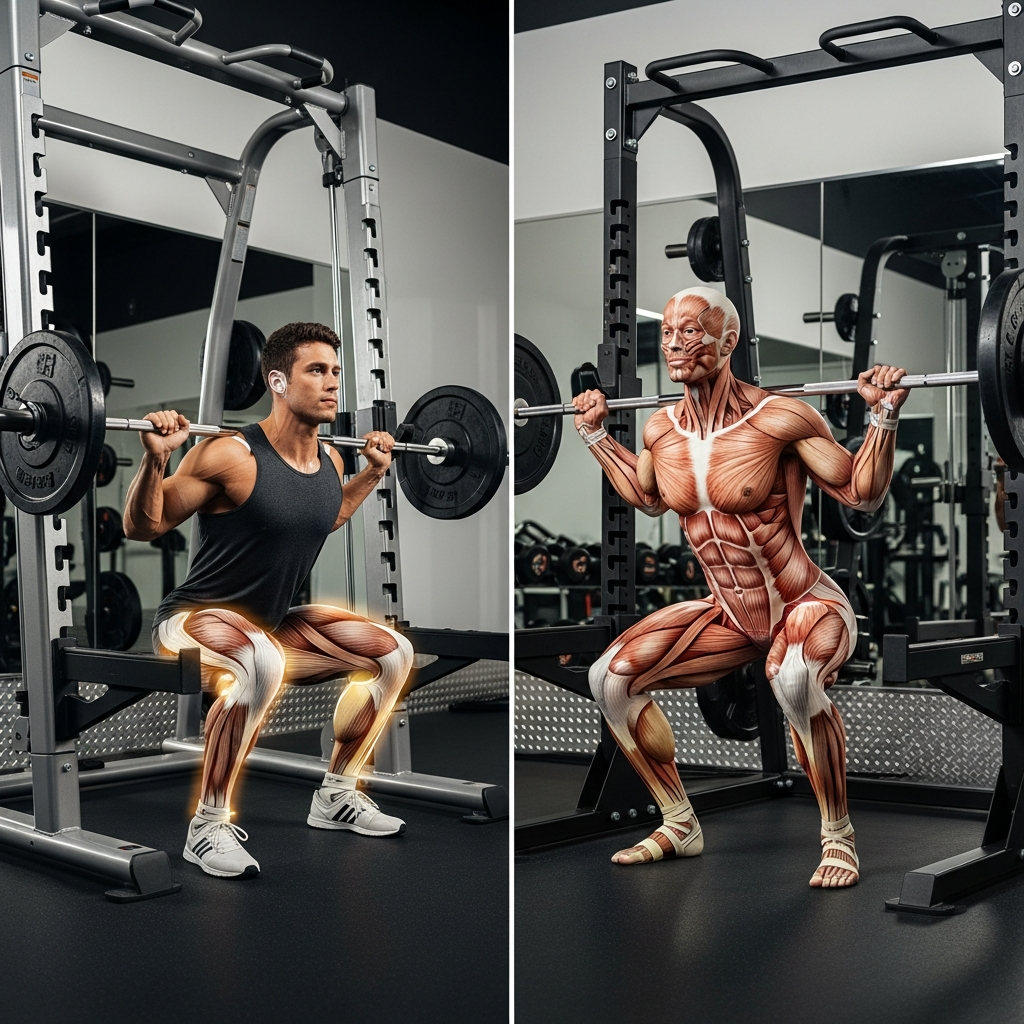
How do these two squats stack up when it comes to building muscle and strength? The answer lies in how each exercise stimulates muscle activation. Both are excellent for strength training and targeting the major muscle groups in your lower body.
However, the differences in mechanics lead to different patterns of muscle engagement. One excels at overall muscle recruitment, while the other allows for more targeted work. Let's look at which muscles are hit hardest and how each contributes to muscle development.
Which Muscles Are Targeted Most in Each Variation?
Both squat variations primarily target the muscles of the lower body, including the quadriceps, glutes, and hamstrings. However, the degree to which specific muscles are engaged differs. The barbell squat is a true full-body lift. It recruits a large number of muscle fibers not only in your legs but also in your core, back, and hips, which work hard to stabilize the weight.
The Smith machine squat allows for more targeted activation. By adjusting your foot placement, you can shift the emphasis. Placing your feet directly under the bar will heavily target the quads. Moving your feet forward by about 12-18 inches will increase the involvement of the glutes and hamstrings, making it a great tool for isolating these specific muscle groups.
So, while the barbell squat activates more muscle groups overall, contributing more to functional strength, the Smith machine can be superior for focusing on specific muscles within your leg day workout.
smith machine squat vs barbell squat for Muscle Growth
When the goal is muscle growth, both squats can be effective, but they work in different ways. The barbell squat promotes overall muscle mass by engaging a wider range of muscles, including stabilizers. The need to control the free weight creates a greater stimulus for muscle development across the entire body.
On the other hand, the Smith machine can also be a powerful tool for muscle growth, especially with my years of intense workout experience. Because the machine provides stability, you may be able to lift heavier weights than you could with a barbell. Research has shown that lifters are often about 5% stronger on the Smith machine squat. Being able to manage heavier weights provides a strong stimulus that promotes muscle growth.
Ultimately, a combination of both might be best. Use barbell squats to build a strong, functional base and activate more muscles. Then, use the Smith machine to isolate specific muscles or safely push past fatigue with heavier weights, maximizing your potential for muscle development.
Core Engagement and Functional Strength Comparison
For developing core engagement and functional strength, the barbell squat is the clear winner. The act of balancing a heavy barbell on your back requires constant core activation. Your abdominal and lower back muscles must work in unison to maintain a neutral spine and transfer force from your legs to the bar. This builds the kind of real-world strength needed for lifting heavy objects or performing athletic movements.
The Smith machine significantly reduces the need for core and stabilizer muscle engagement compared to front squats. Since the bar is on a fixed path, your core doesn't have to work as hard to keep you stable. While you should still brace your core during a Smith machine squat, the muscle activation is nowhere near the level required for a free-weight squat.
As a result, while both exercises build leg strength, only the barbell squat truly develops the full-body coordination and core stability that define functional strength. The recruitment of stabilizer muscles is a key advantage of the barbell squat.
Safety, Form, and Injury Risk
Safety is a top priority in any workout, and the squat is no exception. Both the smith machine squat and barbell squat come with their own set of considerations regarding injury risk. Proper form is paramount in both exercises to prevent unnecessary strain, especially on the lower back and knees.
Understanding the safety features and potential pitfalls of each squat can help you train hard while minimizing your risk of injury. We'll examine how each lift impacts your joints and which might be safer, particularly for beginners.
Joint and Lower Back Considerations
The barbell squat, when performed with poor form, can place significant stress on the lower back and knees. Rounding your back or letting your knees collapse inward are common mistakes that increase injury risk. However, with proper form, the free-weight movement allows your body to move through its natural range of motion, which can reduce unnatural joint stress.
The Smith machine's fixed path can be a double-edged sword. While it provides stability, it can also force your body into an unnatural movement pattern that doesn't align with your individual biomechanics. This can sometimes place more shear force on the knees and lower back, especially if your foot placement is off or if the machine's path is not perfectly vertical.
In summary, joint stress differs based on form and movement path. A barbell squat with good form can be very safe, while a Smith machine can place awkward stress on joints if it forces you into an unnatural position. No matter what equipment you use, make sure correct squat technique is always your top priority.
Is the Smith Machine Safer for Beginners?
For many beginners, the smith machine squat can feel safer, and in some ways, it is. The fixed path eliminates the fear of losing balance and falling over, which is a common concern with free weights. The ability to lock the bar in place at any time provides a psychological and physical safety net, especially when training alone.
This controlled environment allows beginners to focus on the feel of the squatting motion and build confidence. It helps them learn to engage their quads and glutes without the added complexity of stabilizing a heavy bar. This can reduce the initial risk of injury that might come from attempting a barbell squat with underdeveloped stability and poor form.
However, over-reliance on the Smith machine can be a downside. It doesn't teach the crucial skill of balancing a free weight, which is essential for progressing to barbell squats. While it's a good starting point for safety, the ultimate goal should be to master form and transition to free weights for greater functional benefits.
Injury Prevention Tips for Both Squat Types
No matter if you opt for the Smith machine or a traditional barbell, focusing on preventing injuries is essential for lasting progress; above all, learning correct technique should come before increasing the load. Lifting heavier should never compromise your squat form.
Begin with lighter weights to perfect your technique.For barbell squats, this means keeping your chest up and back straight. For Smith machine squats, it means finding a foot position that feels natural and doesn't strain your knees or back. A major downside of the Smith machine is that its fixed path can mask mobility issues that would be apparent with a barbell, so be mindful of any joint discomfort.
Here are some universal tips for injury prevention:
- Always warm up thoroughly before squatting.
- Brace your core throughout the entire movement to protect your lower back.
- Don't be afraid to use a spotter or the safety arms on a squat rack for heavy lifts.
(ALSO READ: Hack Squat vs Barbell Squat: Which One Builds More Muscle?)
Pros and Cons of Smith Machine Squats and Barbell Squats
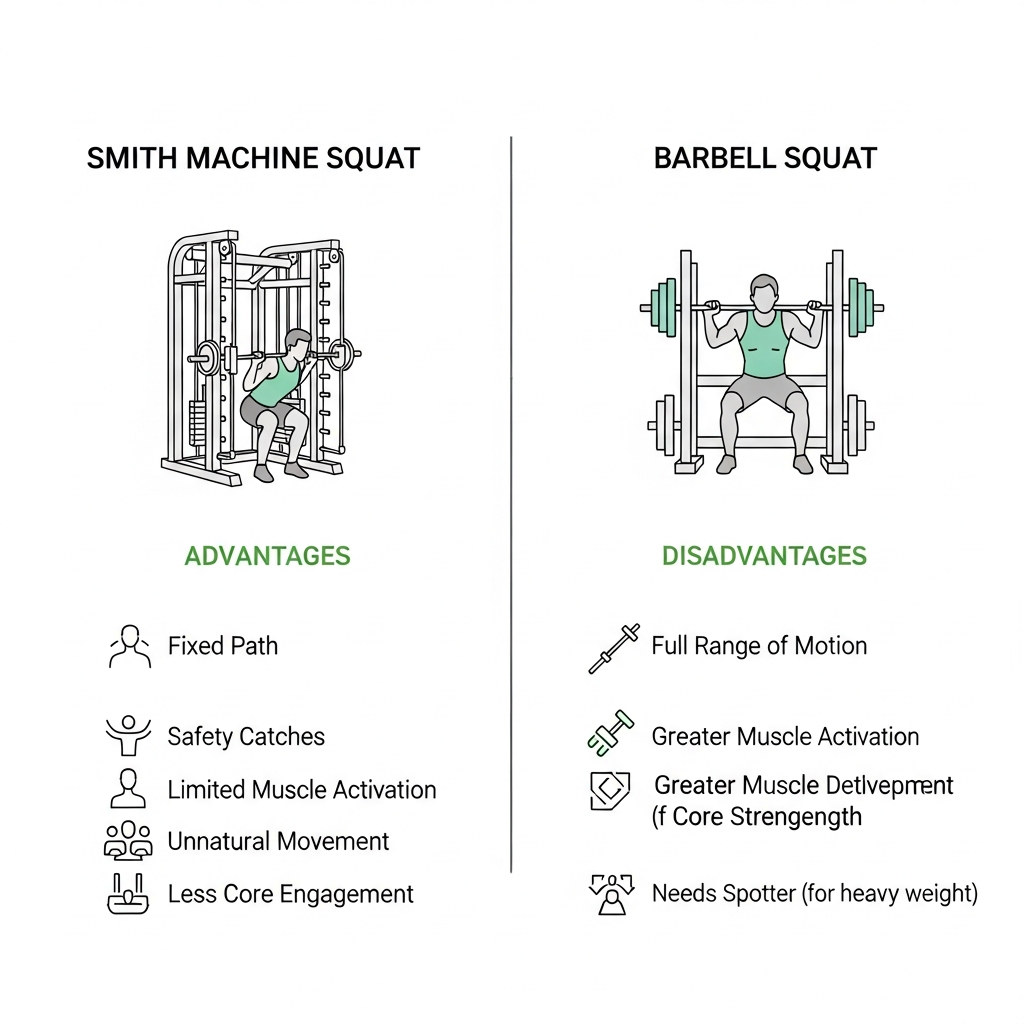
Every exercise has its own set of pros and cons, and the choice between the smith machine and barbell squat is no different. Each offers unique benefits that might make it a better fit for your specific goals, experience level, and even how you're feeling on a particular day.
By breaking down the advantages and disadvantages of each, you can get a clearer picture of where they fit into a well-rounded training program. Let's weigh the good against the bad for both of these popular leg-builders.
Smith Machine Squat Advantages and Disadvantages
The smith machine squat offers several advantages, especially for certain goals. The fixed bar path provides stability, but it can also result in a limited range of motion, which is great for beginners learning the movement or for anyone looking to safely push to failure without a spotter. This stability also allows for excellent muscle isolation.
However, there are notable disadvantages. The fixed path can force you into an unnatural movement pattern, which is one of the main downsides. It also significantly reduces the activation of important stabilizer muscles, limiting the development of functional strength and core stability.
Here's a breakdown:
- Advantages: Increased safety for solo lifters, great for muscle isolation, allows for heavier loads due to stability.
- Disadvantages: Unnatural movement path for some, less stabilizer muscle engagement, limited functional strength benefits.
Barbell Squat Advantages and Disadvantages
The barbell squat is the king of leg exercises for good reason. Its primary advantage is the development of functional strength through full-body activation. It forces your stabilizer muscles to work overtime, building balance and coordination that translates to other lifts and everyday life.
The biggest disadvantage is the higher risk of injury if performed with poor form. It has a steeper learning curve, and lifting heavier weights safely requires a squat rack and often a spotter. Interestingly, while it builds more overall strength, most people can actually lift heavier weights on a Smith machine because the stability is provided for them.
Let's summarize:
- Advantages: Builds superior functional strength, massive muscle activation (including stabilizers), improves balance and coordination.
- Disadvantages: Higher risk of injury with poor form, requires more equipment for safety, steeper learning curve.
(ALSO READ: Barbell Hack Squat: A Hidden Gem for Leg Day Gains)
Conclusion
In conclusion, both Smith Machine squats and barbell squats offer unique advantages and challenges that cater to different fitness levels and goals. While the Smith Machine provides added stability, making it a great choice for beginners or those recovering from injury, the barbell squat delivers a more functional movement that engages stabilizing muscles and promotes overall strength. Ultimately, incorporating both variations into your workout routine can lead to well-rounded leg development and greater muscle activation. Understanding your individual needs and preferences is essential in choosing the right squat type for your fitness journey. Whichever option you decide on, remember that proper form and technique are key to maximizing benefits and minimizing injury risk. Happy squatting!
Frequently Asked Questions
Can I Build Leg Strength With Only Smith Machine Squats or Do I Need Both?
Yes, you can absolutely build significant leg strength and muscle using only the smith machine squat. It allows for progressive overload and targets major muscle groups effectively. However, incorporating barbell squats will provide greater overall muscle activation and functional strength benefits that the Smith machine alone cannot replicate.
Should You Choose a Smith Machine or a Squat Rack for Your Home Gym?
For a home gym, a squat rack is generally more versatile, allowing for barbell squats, bench presses, and other free-weight exercises. However, if safety during solo workouts is your top priority or your fitness level is at the beginner stage, a smith machine can be a more secure investment.
Are Smith Machine Squats a Good Alternative if I Have Lower Back Issues?
A smith machine squat can be a good alternative if you have lower back issues, as the stability can reduce strain. However, the fixed squat mechanics can also place unnatural stress on the spine if your form is incorrect. You should pay attention to what your body tells you and seek guidance from an expert.
REFERENCE:
https://pubmed.ncbi.nlm.nih.gov/15705030/
https://www.researchgate.net/publication/319183684_Smith_Machine_exercise_the_key_points
https://mathoverflow.net/questions/511514/what-is-the-unit-distance-exponent
https://stackoverflow.com/help/whats-reputation
https://stackoverflow.com/questions/79943567/off-by-one-when-counting-words-in-dictionary
https://mathoverflow.net/questions/511556/group-actions-on-the-coefficients-of-group-homology